A week before Oliver died, he cupped my face in our bedroom like he was trying to memorize me.
The light in the room was soft and tired. The curtains hung half-closed, letting in a strip of late afternoon sun that didn’t reach the bed. Oliver’s hands were warm — still warm then — and his thumbs brushed beneath my eyes as if he could smooth away what he already knew was coming.
I tried to smile. I tried to make it small, dismissible, like a line from an overdramatic film. That was my reflex with fear: shrink it until it fit somewhere I could control.
“Why are you talking like this?” I asked, forcing a little laugh.
Oliver’s smile didn’t lift. It was quiet and weighted — the kind that carries truth it doesn’t fully reveal. He looked at me the way he always did when he wanted me to understand something without pushing.
I wanted to argue. I wanted to say his family wasn’t that bad. That his mother’s coldness was just her generation. That Lydia’s performative cruelty was just insecurity. That Edward’s silence was just awkwardness.
I wanted to say those things because saying them meant I wouldn’t have to look directly at what I already knew: they tolerated me because Oliver insisted. Their civility was never mine. It was borrowed.
So instead of arguing, I pressed my cheek into his palm and said the only thing that mattered.
Oliver kissed my forehead, and for a heartbeat I thought we could outwish reality.
Seven days later, my world split open with a single phone call.
Car accident. On his way home from his lawyer. Final documents signed. His software company officially sold. Four hundred and eighty million dollars — after taxes — transferred into his estate. And I, his wife, the person he chose, was the sole heir.
When the call ended, the air in my lungs felt wrong. Like breathing had become a task without purpose.
I sat on the kitchen floor and stared at the pattern in the tile until my vision blurred. The first thing I felt wasn’t hysteria.
It was blankness.
I don’t remember who drove me to the hospital. I don’t remember the hallways. I remember the smell — sterile and sharp — and the way my hands shook when I signed papers I couldn’t read through the blur. I remember seeing him. Still. Unfairly still. And I remember thinking, absurdly, that Oliver looked like he was simply waiting for me to say something smart, something calm, something that would fix it.
But there was nothing to fix.
There was only the after.
The Harringtons didn’t know yet. Not the details. Not the truth Oliver had locked behind legal structures like steel doors. They knew he’d died. They knew there was money. But they didn’t know where it landed.
So they behaved exactly as they always had.
Like the world belonged to them. Like I was a guest they could finally escort out.
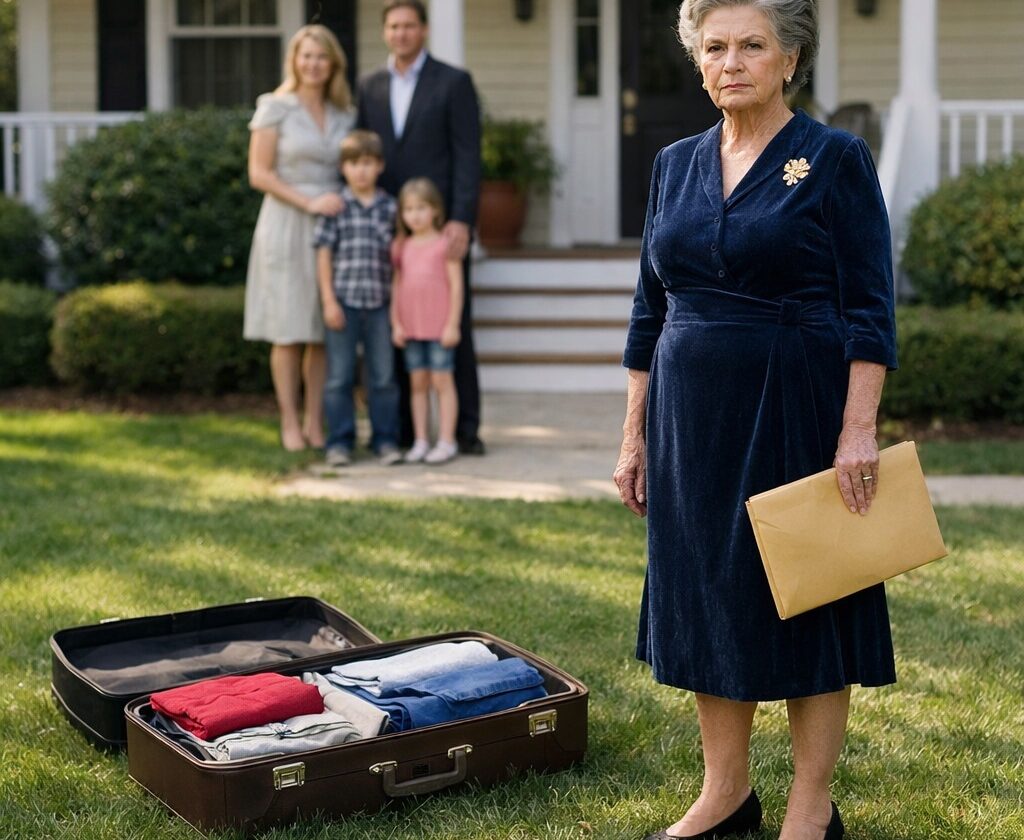
Margaret stood on the lawn pointing at black garbage bags Lydia had brought for “my belongings.” Edward stood behind her, silent and avoidant. Lydia held her phone up, filming everything, mouth tilted in a little smile like she’d found content worth posting. My wedding album lay face-down in the grass, its spine bent, a smear of mud darkening the cover.
“You have one hour,” Margaret said flatly. “Pack and leave.”
Something in me should have shattered.
But it didn’t.
Because the humiliation was familiar. It was simply no longer buffered by Oliver’s presence. They weren’t taking my home. They were proving it had never been mine.
I bent down, picked up the album, brushed off the dirt with the side of my hand, and stood.
Lydia blinked. She wanted tears. She wanted the kind of breakdown she could capture, crop, and post. I gave her nothing.
I moved through the rooms without rushing. I loaded my old Toyota with the things that mattered: my scrubs, my books, photos of Oliver and me laughing in a diner booth, a chipped mug he swore brought luck, a sweater that still smelled like him in the way only grief can make you notice.
As I carried the last box to the car, I heard Lydia laugh with Margaret — light, sharp — and Edward popped a bottle of champagne like they were celebrating a business deal.
Celebrating.
I didn’t cry.
My grief was waiting. Patient. It always was.
I moved into a small studio across town. Worn carpet. One window facing a brick wall. The light came in reluctantly, as if even the sun didn’t want to linger there.
The first night I sat on the floor with my back against the wall and listened to the building settle around me — pipes, footsteps, distant TV noise. It wasn’t luxurious. It wasn’t quiet. But it was mine.
I took a job at a community clinic. The pay was low. The work was honest. People didn’t care who I’d married. They called me by my name, and in that simple fact I found a kind of relief that surprised me.
The money stayed untouched. Locked behind trusts Oliver’s lawyer had designed carefully — silent, secure, unreachably precise.
Nearly half a billion dollars.
And I rode the bus.
I kept the secret because I needed to know something Oliver had already suspected: who would be kind to me when they believed I had nothing? Who would show up without the promise of reward?
The Harringtons answered that question quickly and thoroughly.
Lydia accused me of stealing jewelry. When I returned it with receipts, she posted a photo wearing it with the caption: Family things stay with family. Strangers in the comments called me a gold digger. Margaret called my workplace pretending to have “concerns.” Edward sent a formal letter requesting I stop using the Harrington name.
I framed it.
Not because it was funny. Because it was proof of how thoroughly they wanted me to disappear.
Daniel started meeting me for coffee. Not often — just enough that I knew it wasn’t a one-time guilt gesture. He looked different without Oliver around. Less confident. Less protected. Like he’d spent his whole life under the Harrington shadow and didn’t know how to stand in direct light.
Daniel had brought me Oliver’s notebooks from the attic. His baseball glove. The teddy bear I’d given Oliver our first Christmas — the one he’d claimed was ridiculous and then kept on his side of the bed anyway.
“I’m sorry,” Daniel had whispered then. “I know it doesn’t fix anything.”
“Apologies don’t make you brave,” I’d replied.
At the coffee shop, weeks later, he slid two hundred dollars across the table.
I stared at it. I didn’t need it. But I understood why he did it. It wasn’t charity. It was an attempt to balance something inside him. So I accepted it — not because I wanted his money, but because he needed to give it.
He almost smiled. Almost.
Edward’s email arrived through my lawyer. Written in careful corporate language, the kind that pretends nothing emotional is happening.
We would like to discuss a potential investment opportunity. Confidential. Time-sensitive. Ten million dollars.
My lawyer called. “They’re asking for an infusion to stabilize a deal,” he said. “They need liquidity.”
“Why?” I asked, already knowing.
“Because without Oliver, their leverage is weaker. And because they miscalculated.”
“Miscalculated what?”
A pause. “You.”
I looked at the framed letter on my studio wall — Edward’s request that I stop using the Harrington name — and laughed once, quiet and sharp.
We met at an upscale restaurant. White tablecloths, low lighting, the kind of place where people spoke softly because they believed money required reverence. I wore plain clothes. The power wasn’t in my outfit. It was in what I knew and what they didn’t.
Edward arrived first. Margaret followed. Lydia came last, filming on her phone until a host asked her to stop.
Their eyes landed on me and froze.
Margaret went pale. For a split second, the room went silent in a way that felt almost theatrical.
“You,” Margaret said, voice thin with shock. “Why are you here?”
“Because you asked for my money,” I said.
My lawyer slid a document across the table. My name. Sole heir. Sale proceeds. Four hundred and eighty million dollars after taxes. Trust structures. Finality. The kind of legal clarity that leaves no room for Margaret’s charm or Lydia’s performance.
Margaret recovered first — people like Margaret always do. They are trained to turn humiliation into offense.
“Family supports family,” she said.
I looked at her calmly. “You evicted me,” I replied. “You threw my wedding album into the grass.”
Lydia hissed. “Oh my God, here we go.”
I turned my gaze to her. “You filmed it,” I said. “So yes. Here we go.”
Edward tried to salvage something. “We’re here to talk business,” he said.
“Good,” I said. “Because I’m here to say no.”
Silence.
“I decline the investment,” I continued, tone even. “I’m not financing your life after you tried to erase mine.”
Margaret’s voice rose. “You owe us,” she snapped, the mask cracking. “You married into this family. You took our name—”
I reached into my bag and placed the framed letter on the table — Edward’s formal request that I stop using the Harrington name — like a prop I’d saved for exactly this moment.
Margaret stared. Edward’s eyes widened. Lydia’s mouth fell open.
“You framed that?” Lydia said, incredulous.
“Yes,” I replied. “It reminded me who you are.”
Margaret demanded, “So what — you’re going to punish us?”
I shook my head. “No,” I said. “I’m going to honor Oliver.”
“What do you want?” Margaret finally demanded, voice stripped of performance.
“I want the property,” I said calmly. “The Harrington house.”
Lydia let out a sharp laugh. “Absolutely not.”
“You need ten million dollars,” I said. “And without it, your empire collapses.”
Edward’s jaw tightened. “What do you plan to do with it?” he asked carefully.
I inhaled slowly. The answer had been forming in me for months, ever since I sat in my studio staring at a brick wall and realized money didn’t heal grief — but it could still be used like love.
Silence — not the kind that came from contemplation. The kind that came from disbelief.
“First month free for widows and single mothers,” I continued. “And it will carry my husband’s name.”
Margaret’s expression warped with fury. “You’re doing this to spite me.”
I shook my head. “I’m honoring Oliver. And I’m doing it without your permission.”
As I stood to leave, Margaret’s voice cut after me, sharp and shaking.
“You don’t belong,” she hissed.
I paused and turned just enough to meet her eyes.
Then I walked out.
The deal moved faster than people expected. Edward needed cash more than Margaret needed pride. Signatures were exchanged. The property transferred. Workers arrived. Fences went up. Old rooms were gutted and reimagined.
The grand dining room where Margaret once hosted perfect dinners became a community meeting space. The manicured lawn became a garden area. The upstairs bedrooms became safe, clean apartments with simple locks that clicked firmly.
When the Oliver Harrington Memorial Residence opened, the air was bright and crisp. Fifty families were scheduled to move in — widows, single mothers, families that had been living out of motel rooms. People who didn’t care about Harrington prestige and never had.
A reporter asked: “Is this revenge?”
I looked at the families walking in with boxes, children holding stuffed animals, women with tired eyes and careful hope.
After the speeches, after the photos, after the first families moved in, I walked through the building alone. The halls smelled like fresh paint and new beginnings. The locks clicked. The lights were warm.
In the new community room, there was a plaque.
I ran my fingers over the letters. For a moment, I felt Oliver’s absence like a physical thing. Then I felt something else too — something quieter.
Hope. Not the naive kind. The earned kind.
Daniel came to the Residence late one afternoon, long after reporters stopped caring. No cameras. No speeches. Just a cold breeze moving through the courtyard and the sound of kids playing in the garden area.
He stopped in front of the plaque with Oliver’s name and stared at it for a long time.
Then he reached into his pocket and pulled out something small — a folded piece of paper, worn at the edges. “I found this,” he said. “In Oliver’s desk.”
He held it out. I took it carefully and unfolded it.
My throat tightened so hard it hurt.
“He wrote that for us,” Daniel whispered. “And we still did what we did.”
I folded the note carefully and slipped it into my pocket like it was a living thing.
“I don’t forgive you yet,” I told him honestly.
Daniel nodded quickly, accepting it.
“But,” I added, “I believe you. That’s not forgiveness. It’s just a door. A small one.”
His breath hitched. “Thank you,” he whispered.
I shook my head. “Don’t thank me. Go do better.”
I met Lucas in a bookstore. It wasn’t romantic the way people like to imagine love arriving. It was mundane. It was a Tuesday. It was raining lightly outside, the kind of drizzle that makes the city smell like paper and wet pavement.
I was standing at the counter with two used books. I reached into my pocket for cash — coins, crumpled bills. I was short. Not by much. But enough to make the cashier pause awkwardly.
Before I could speak, the man behind me stepped forward.
“I’ve got it,” he said. His voice was calm. Not performative. Not the kind that seeks praise.
He was holding a small stack of books — education titles, a worn copy of To Kill a Mockingbird, something about lesson planning. His hair was damp from the rain, jacket slightly rumpled. He looked like someone who lived in reality.
“You don’t have to,” I said quickly.
He shrugged lightly. “It’s a couple bucks. No big deal.”
As I walked toward the door, he called after me.
“Hey — you dropped this.” He held up a cheap black pen. The kind I carried everywhere out of habit.
“You borrow pens a lot?” he asked, smiling.
I let out an actual laugh — unexpected and bright.
“Only when my life is messy,” I said before I could stop myself.
He tilted his head. “Then you probably need to keep that one.”
When I told Lucas everything — Oliver, the Harringtons, the money, the Residence — he listened without flinching. When I finished, he sat back and considered me for a moment. Then he smiled. “So you’re rich,” he said. “Does that mean you’ll stop borrowing my pen?” I stared at him. Then I laughed — big, loud laughter that startled me with its own sound. “No. Probably not.” He grinned. “Good. Because I like having an excuse to see you.”
It wasn’t a grand declaration. It didn’t erase grief. It didn’t fix the past. But it was something quiet and real, offered without demand.
Hope doesn’t always arrive as fireworks. Sometimes it arrives as a borrowed pen returned.
And I learned this:
You don’t win by becoming cruel.
You win by becoming free.
You May Also Like
She Gave Everything to Her Family — Until the Day She Finally Stopped
Emotional Stories
He Left His Entire Fortune to a Stranger — The Reason Left Everyone Speechless
Life & Legacy
What Grief Actually Feels Like — And Why It Doesn’t Follow the Rules
Grief & Healing
The Widow Who Turned Her Pain Into 50 Families’ Hope
Inspiring Stories
The Letter He Left Her Before He Died Said Everything She Needed to Hear
Love & Loss
Starting Over After 40: Stories of Women Who Rebuilt Everything
Resilience & New Beginnings
“I belonged to Oliver. That was enough.”
This story isn’t about money. It never was. It’s about what people show you when they believe you have nothing. It’s about how grief changes shape but never fully leaves. It’s about the quiet, patient work of becoming free — not through revenge, but through choosing, every single day, who you want to be.
Oliver planned for everything. He planned for their cruelty. He planned for her grief. And somehow, in his love, he’d planned for what she would build from the ashes of it all.
If this story moved you — share it with someone who needs it. 💛