
The Strange Thing on the Bathroom Floor: How Fear Fills the Gaps Before Facts Arrive
I froze the second I noticed it.
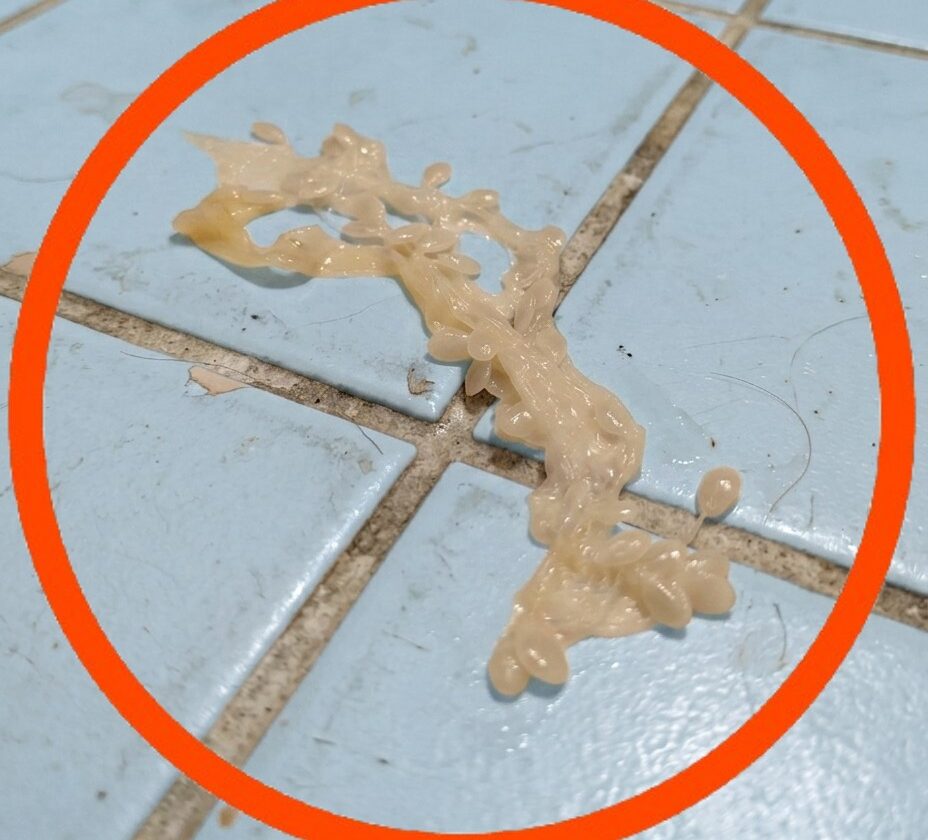
Something strange was stuck to the bathroom tiles near the corner of the wall—translucent, glossy, almost alive-looking. It had a soft, jelly-like appearance, irregular and organic in shape, as though it had slowly crawled there and hardened in place.
For a few long seconds, I just stared at it.
Then my mind did what anxious minds often do: it skipped straight past logic and landed in catastrophe.
Parasites.
Egg sacs.
Something growing from the drain.
An infestation we hadn’t noticed.
When my girlfriend walked in and saw it too, her reaction matched mine almost instantly. Silence. Confusion. That subtle tightening in the chest that happens when your brain encounters something unfamiliar and immediately labels it dangerous.
Neither of us touched it.
Instead, I grabbed my phone.
When Uncertainty Becomes Panic
I crouched down and started taking photos from different angles, zooming in as if the camera might reveal something reassuring my eyes couldn’t.
It didn’t.
If anything, the close-ups made it worse.
The strange object looked even more biological under the harsh phone flash—wet-looking, textured, almost disturbingly natural. The more I stared, the more convinced I became that something was seriously wrong in the apartment.
And then came the internet spiral.
I uploaded photos.
Searched forums.
Scrolled through terrifying possibilities.
Anyone who has ever searched symptoms online already understands how quickly uncertainty can mutate into panic. The internet rarely begins with the most likely explanation. It jumps immediately toward worst-case scenarios.
Within minutes, I had mentally transformed an unknown blob on bathroom tile into:
- A parasite colony
- Insect larvae
- Drain organisms
- Mold growth
- Something toxic
- Something dangerous
Every answer made me more anxious than the last.
At one point, I genuinely considered leaving the apartment for the night.
The Brain’s Need for Explanation
What struck me later was how quickly my mind rejected ordinary explanations in favor of alarming ones.
Psychologists sometimes refer to this as catastrophic thinking—the brain’s tendency to interpret uncertainty as threat, especially when something looks unfamiliar or unsettling.
Human beings are wired to detect danger quickly. From an evolutionary perspective, assuming the worst once helped people survive.
If our ancestors hesitated too long around something strange, the consequences could be serious.
So the brain often fills informational gaps with fear before evidence arrives.
Especially when:
- Something looks biological
- We feel uncertain
- We lack immediate explanation
- The environment feels vulnerable (like bathrooms, basements, or bedrooms)
- We’ve already consumed alarming information online
The mind begins building a story long before facts appear.
And once fear enters the narrative, everything starts looking suspicious.
The Surprisingly Ordinary Truth
Then finally, buried beneath dozens of dramatic theories online, someone gave a simple answer.
“It looks like melted hot glue.”
That was it.
No parasites.
No infestation.
No living organism.
Just hot glue that had dripped accidentally, cooled, and hardened into a bizarre shape against the tile.
I remember staring at the message for a few seconds in disbelief.
Then came the relief.
Immediate. Almost laughable relief.
The kind that makes your entire nervous system unclench at once.
We checked more closely afterward, and of course, that explanation made perfect sense. The glossy texture. The translucent color. The hardened drips.
Once we understood what it actually was, it became impossible not to see it clearly.
And suddenly the thing that had terrified us minutes earlier looked completely harmless.
Why Ordinary Things Sometimes Look Terrifying
The experience stayed with me because it revealed something surprisingly human:
Fear often grows best in uncertainty.
When the brain lacks information, it starts constructing meaning on its own. And unfortunately, anxious minds are rarely creative in comforting directions.
A strange shape becomes danger.
A sound becomes threat.
A symptom becomes disease.
An unanswered message becomes rejection.
The mind fills empty spaces quickly—and not always accurately.
Researchers who study anxiety often note that ambiguity itself can feel threatening. Humans generally prefer even unpleasant certainty over unexplained uncertainty.
That’s why unfamiliar things can feel so disturbing, especially in places associated with privacy and safety, like the home.
The Internet Spiral Effect
One thing that intensified the panic was endless searching.
Modern technology gives people immediate access to information, but not necessarily proportionate information.
Online forums often amplify extreme explanations because dramatic answers attract more attention.
A harmless issue can quickly become:
- Rare disease speculation
- Infestation horror stories
- Worst-case medical scenarios
- Urban legends presented as fact
Without context, anxious minds absorb those possibilities rapidly.
This phenomenon is so common that health experts even have a term for excessive online symptom searching: cyberchondria.
And it doesn’t only apply to health.
The same pattern appears with:
- Home concerns
- Strange smells
- Skin changes
- Appliance noises
- Unknown objects
- Environmental fears
The brain searches for certainty but accidentally feeds panic instead.
Why We Laugh After Fear Passes
Later that evening, my girlfriend and I laughed about the whole situation.
Not because the fear felt fake in the moment—it felt completely real—but because hindsight suddenly made the panic seem wildly disproportionate.
That emotional shift happens because once the nervous system receives safety confirmation, the brain can finally reinterpret the experience rationally.
What once appeared threatening becomes almost absurd.
But the reaction itself was still deeply human.
A Reminder About Perspective
The experience reminded me how often fear is built from incomplete information.
Sometimes the scariest thing isn’t the object itself.
It’s the story we create before understanding it.
A shadow becomes a figure.
A noise becomes an intruder.
A harmless substance becomes evidence of disaster.
The mind is incredibly powerful at constructing narratives in uncertainty.
And while that instinct once helped humans survive genuine danger, modern life sometimes turns that survival mechanism against us.
Final Thoughts
In the end, the strange thing on the bathroom floor was nothing more than cooled hot glue.
Ordinary.
Harmless.
Forgettable.
But the emotional journey around it revealed something much larger: how quickly uncertainty can transform into fear when imagination outruns evidence.
And maybe that’s worth remembering the next time something unfamiliar appears in the quiet corners of life.
Not every mystery is dangerous.
Not every unknown is a threat.
Sometimes the mind simply reaches for the worst explanation because it hates empty spaces.
And sometimes peace arrives the moment we finally understand what we’re actually looking at.