Why Coins Have Ridges Around the Edges — The Surprising History Behind a Tiny Detail
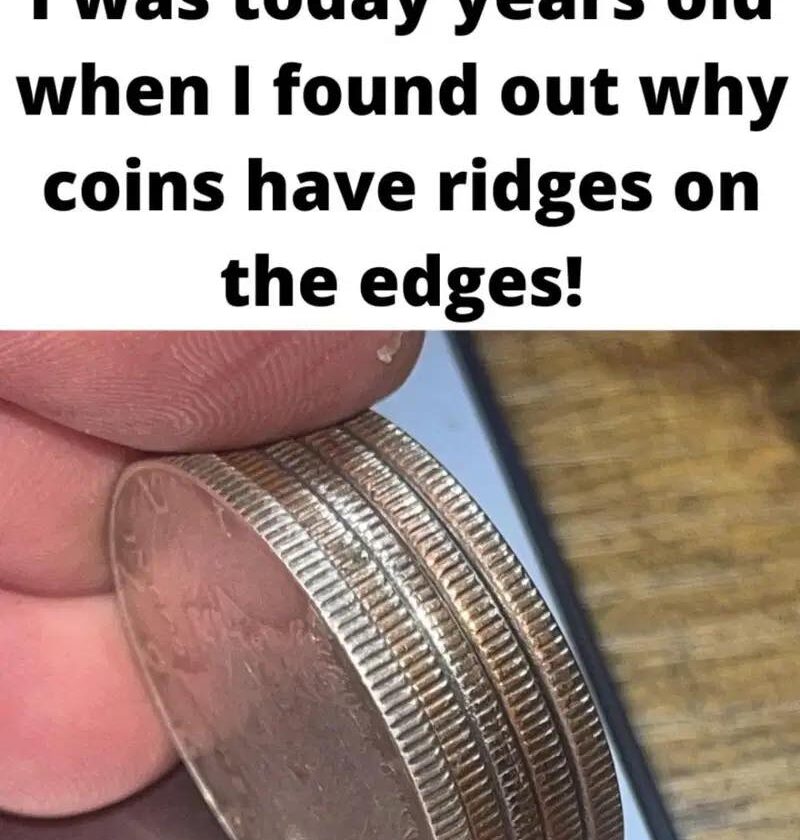
You’ve probably handled thousands of coins without ever noticing the tiny ridges running along their edges.
Quarters slide across checkout counters. Dimes disappear into cup holders. Loose change rattles around in drawers and pockets until the details become almost invisible through familiarity.
But those small grooves are not decorative.
They exist because, centuries ago, entire economies were being quietly stolen one coin at a time.
What looks like a simple texture today is actually the surviving evidence of one of history’s earliest anti-counterfeiting technologies — a clever solution born from fraud, precious metals, and the growing need for public trust in money.
When Coins Were Made of Real Silver and Gold
Hundreds of years ago, coins were far more valuable than modern coins today.
That’s because many currencies were made from real gold or silver.
A coin’s value did not just come from the government stamp printed on it. The metal itself carried genuine worth. If you melted the coin down, the silver or gold still retained value on its own.
And wherever valuable metal exists, someone eventually finds a way to steal it.
That’s exactly what happened through a practice called coin clipping.
The Crime Called “Coin Clipping”
Criminals discovered they could shave tiny amounts of precious metal from the edges of coins without making the coins look obviously damaged.
A clipped coin could still be spent normally because the missing metal was difficult to notice during everyday transactions.
Meanwhile, the stolen silver or gold shavings were collected over time and melted down separately for profit.
One clipped coin barely mattered.
But across thousands of coins circulating through markets, shops, and governments, the losses became enormous.
The consequences spread quickly:
- Merchants began distrusting currency
- Governments lost valuable metal reserves
- Counterfeiting increased
- Economic confidence weakened
Money only works when people trust it.
And coin clipping slowly damaged that trust.
The Unexpected Role of Isaac Newton
One of the most fascinating parts of this story involves Isaac Newton.
Most people know Newton for gravity, physics, and mathematics.
But in 1696, he was appointed Warden of the Royal Mint in England.
Unlike many officials of the time, Newton took the role extremely seriously.
He aggressively pursued counterfeiters and worked to modernize coin production in order to protect the economy from fraud.
One of the most important innovations introduced during this period was the use of reeded edges — the evenly spaced ridges still found on many coins today.
Why the Ridges Solved the Problem
Once ridges were added to coin edges, clipping became much easier to detect.
If someone shaved metal from the coin, the groove pattern would immediately appear uneven, broken, or incomplete.
A genuine coin, meanwhile, displayed a precise and continuous pattern around the entire edge.
That made tampering obvious.
The ridges essentially acted like an early security feature — similar to modern anti-counterfeiting technology used on paper money today.
And because the grooves were difficult to reproduce accurately, they also made counterfeit coins harder to manufacture convincingly.
In simple terms:
The ridges protected trust in money itself.
Why Some Coins Still Have Ridges Today
Modern coins are no longer made from large amounts of precious silver or gold, so clipping is no longer the major threat it once was.
Yet the ridges remain.
Why?
Because they still serve several useful purposes.
1. Anti-Counterfeiting Measures
Modern vending machines, parking meters, and coin validation systems still use edge patterns to help identify authentic coins.
The grooves create measurable differences that machines can detect.
Even today, coin design still plays a role in preventing fraud.
2. Helping Visually Impaired Individuals
Ridged edges also help many visually impaired people distinguish coins by touch alone.
For example:
- Pennies and nickels usually feel smooth
- Dimes and quarters often feel ridged
That tactile difference makes identifying currency easier without needing to see the coin directly.
3. Tradition and Familiarity
Coins have carried ridges for centuries, and people now expect certain coins to look and feel that way.
Currency design often balances practicality with tradition.
The textured edges connect modern money to a long history of commerce, trade, and economic evolution.
Why Pennies and Nickels Usually Stay Smooth
Historically, pennies and nickels were not valuable enough to make clipping worthwhile.
Since they contained little precious metal, criminals focused primarily on higher-value silver and gold coins instead.
That’s why many lower-value coins traditionally kept smooth edges while more valuable denominations received ridges.
Even though the original economic reasons have mostly disappeared, the design distinction continues today.
A Tiny Detail With a Massive Historical Story
What makes this fascinating is how such a small design feature carries centuries of hidden history.
Those tiny grooves represent:
- Economic protection
- Human ingenuity
- Early anti-fraud technology
- Public trust in currency systems
Most people never think twice about the edges of coins.
Yet every ridged quarter or dime quietly carries the legacy of a time when shaving tiny slivers of silver from currency threatened entire financial systems.
It’s a reminder that even ordinary objects often contain stories far larger than they appear.
And sometimes, the smallest details survive the longest. 💰✨