They Dug a Lake on My Land While I Was Gone — Then I Found Out Why
The first thing I noticed was the color.
Blue.
There was blue where no blue had ever belonged.
I had come over the ridge in my old Ford with the windows down and the late-summer heat pouring through the cab like breath from a furnace. The road behind me was barely a road at all—just two hard-packed tire tracks winding between waist-high grass, sweetgum saplings, and a line of pines my grandfather had planted before my father was old enough to hold an ax.
I had driven that path thousands of times.
I could have followed it blindfolded, though my grandfather would have slapped the back of my head for saying so.
Every rut had a memory.
Every bend had a reason.
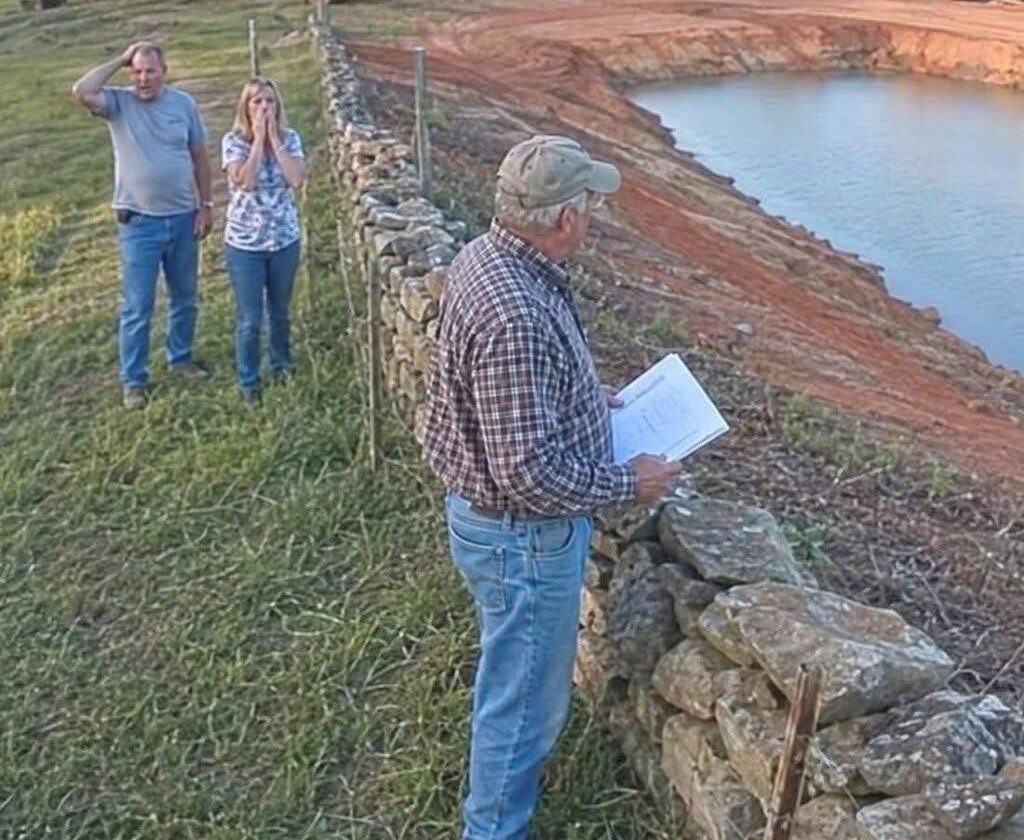
At the top of the ridge, the land opened into my southern pasture exactly as it always had. It rolled toward the spring, dipped into the lower ground, then rose again toward the old stacked-stone fence marking the boundary between Mercer land and the property south of it.
Only now, in the middle of my pasture, sunlight flashed off water.
For several seconds, my mind refused to understand what my eyes were seeing.
At first, I thought it was a mirage.
August in Alabama can do that to a man. Heat rises from the ground, the air turns thick, and distant objects shimmer until they seem to float.
But mirages don’t have cut banks.
They don’t have raw red clay piled into enormous mounds.
And they certainly don’t have excavator tracks carved deep enough to hold yesterday’s rain.
I stopped the truck with one boot still hovering over the brake and stared through the dusty windshield.
Then I killed the engine.
The ticking of the hot motor slowly faded into silence.
And that’s when I realized what had happened.
Someone had dug a lake.
On my land.
Two Acres of My Pasture Were Gone
The pasture below me looked as though someone had taken a giant blade and sliced through it.
Nearly two acres of mixed hardwood and grass had been transformed into a broad basin.
Water had already collected at the bottom.
Brown-blue and perfectly still, it reflected the August sky as if it had always belonged there.
But it hadn’t.
The banks had been shaped by machinery.
Straw had been spread across portions of the exposed soil.
Fresh tire tracks crossed the pasture in every direction.
And then I saw the pipe.
It came from the direction of my spring.
My spring.
The same spring my grandfather had cleaned by hand with a shovel and wheelbarrow.
The same cold water my father used to drink from as a boy.
The same place my wife and I had walked to on hot summer evenings before cancer took her from me.
Now someone had diverted that water into a man-made basin.
I opened the truck door.
The smell reached me before my boots touched the ground.
Diesel.
Wet clay.
Cut roots.
Churned earth.
It smelled like violence dressed up as improvement.
I started walking downhill.
Slowly.
I knew myself well enough to understand that if I moved too quickly, my anger would outrun my judgment.
Young oaks had been snapped in half.
Grass had been flattened beneath heavy machinery.
Roots protruded from the torn earth.
Then I saw something that stopped me completely.
A white oak sapling.
My niece had planted it five years earlier.
It was gone.
All that remained was a torn root ball lying against a mound of red clay.
I stood there staring at it.
Then I looked across the water.
This wasn’t a small pond.
It wasn’t a landscaping project.
It wasn’t something I could dismiss as a misunderstanding.
It was a full-sized, deliberate lake.
Expensive.
Engineered.
Permanent.
And it had been dug on my property without my permission.
My Name Is Daniel Mercer
My name is Daniel Mercer.
My family has owned 480 acres of timber and pasture in northern Alabama since 1962.
My grandfather, Walter Mercer, bought the land from a man named Eli Pritchard, whose family had held it since the Depression.
Back then, the property was nothing impressive.
Half-worn pasture.
Pine scrub.
Mixed hardwoods.
A cold creek running through the lower hollow.
And an old stacked-stone fence along the southern ridge.
But my grandfather saw something other people didn’t.
He saw timber that could be managed.
Pasture that could be restored.
Water that could sustain cattle through dry summers.
And enough land for his children and grandchildren to understand where they came from.
He wasn’t sentimental in the way people usually mean when they use that word.
He didn’t give emotional speeches at dinner.
He didn’t talk much about feelings unless somebody was sick or dying.
But he believed something deeply.
Land was a covenant.
Not property in the way a bank sees property.
Not an asset on a spreadsheet.
Not an investment vehicle.
Land was memory beneath your feet and responsibility over your head.
He taught me how to mend a fence before he taught me how to drive.
He taught me how to read cloud shadows moving across a pasture.
He showed me which pine trees needed thinning.
He taught me how to recognize when muddy water meant someone upstream had done something they shouldn’t have.
And above all, he taught me about boundaries.