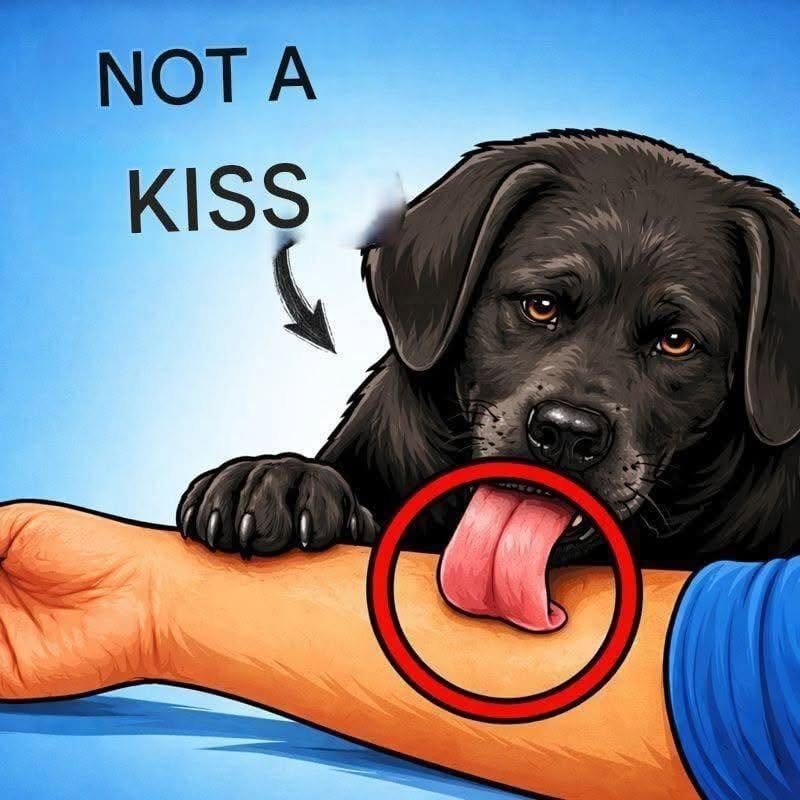
What Does the Research Suggest?
Research into canine behavior supports the idea that licking can serve several different purposes.
Rather than treating licking as a single behavior with one universal meaning, animal-behavior researchers generally consider the dog’s environment, relationship with the person, body language, and circumstances.
This is particularly important when licking becomes repetitive or appears alongside signs of anxiety.
The takeaway is simple:
Context matters.
Is It Safe to Let Your Dog Lick You?
For most healthy adults, an occasional lick on intact skin is generally unlikely to cause a problem.
However, a dog’s mouth is not sterile, and dogs can carry bacteria and other microorganisms.
For that reason, sensible precautions include:
- Avoid letting dogs lick open wounds or broken skin.
- Wash your hands after extensive licking, especially before eating.
- Be cautious about face licking.
- Supervise young children around pets.
- Keep your dog’s vaccinations and veterinary care up to date.
- Maintain regular dental care for your dog.
People with certain medical vulnerabilities should be especially cautious about allowing pets to lick their face, wounds, or medical devices.
When Excessive Licking May Be a Concern
Occasional licking is normal.
But a sudden or obsessive increase deserves attention.
A dog that begins licking people, objects, floors, or itself excessively may be experiencing:
- Boredom
- Anxiety
- Skin irritation
- Pain
- Digestive discomfort
- Environmental stress
- A learned attention-seeking behavior
Excessive licking of a particular part of the body can sometimes indicate an underlying physical problem.
If the behavior is new, persistent, or difficult to interrupt, speaking with a veterinarian is a good idea.
How Can You Tell What Your Dog Is Saying?
Instead of asking, “Why is my dog licking me?”, ask:
“What else is my dog doing right now?”
Licking may be associated with affection when you notice:
- A relaxed body
- Soft eyes
- Loose facial muscles
- Relaxed ears
- A naturally wagging tail
- Willingness to remain close to you
Licking may be associated with stress when you notice:
- A stiff body
- Repeated lip licking
- Pacing
- Excessive panting
- Avoidance
- Tucked tail
- Attempts to escape the interaction
These aren’t absolute rules, but they can help you interpret the behavior more accurately.
Your Dog May Simply Have Learned That It Works
Here’s an interesting possibility: your dog may lick you because you’ve taught them to.
You may not have intended to.
Imagine your dog licks your hand.
You laugh.
Then you pet them.
From your dog’s perspective, the lesson may be straightforward:
Lick → human reacts → attention happens.
The behavior can become stronger through repetition.
That’s why consistency matters when you’re trying to reduce unwanted licking.
What If You Don’t Like Being Licked?
You don’t have to allow licking simply because your dog is trying to interact with you.
You can calmly redirect your dog toward another behavior.
For example, ask for a sit, offer a toy, or reward calm behavior.
Avoid turning the situation into an exciting game. If licking consistently produces a big reaction, your dog may interpret even your attempts to stop the behavior as attention.
Gentle, consistent boundaries can help your dog understand what you prefer.
Frequently Asked Questions
Why does my dog lick me so much?
Dogs may lick people for affection, attention, curiosity, social communication, or stress. If the behavior suddenly becomes excessive, consider discussing it with a veterinarian.
Does a dog licking you mean they love you?
It can be a sign of affection and social bonding, but licking does not have one universal meaning. Your dog’s posture and behavior provide important context.
Why does my dog lick my hands?
Hands can carry interesting smells and tastes, including salt from sweat and traces of food. Your dog may also have learned that licking your hands gets attention.
Should I let my dog lick my face?
It’s generally safer to avoid allowing dogs to lick your face, eyes, mouth, or open wounds. Good hygiene and regular veterinary care are important.
Why has my dog suddenly started licking everything?
A sudden increase in licking can sometimes be associated with anxiety, boredom, pain, skin irritation, or digestive problems. Persistent or unusual behavior should be discussed with a veterinarian.
Final Thoughts
A dog licking you can certainly be a sign of affection—but that’s only part of the story.
Your dog might be saying “I love you,” “Pay attention to me,” “You taste interesting,” or “I’m feeling uncomfortable.”
The key is to look beyond the lick.
Pay attention to the ears, eyes, tail, posture, environment, and what happened immediately before the behavior.
Once you start looking at the whole picture, your dog’s seemingly simple actions can become much easier to understand.
Sometimes a lick really is a kiss. Other times, your dog is telling you something completely different.