
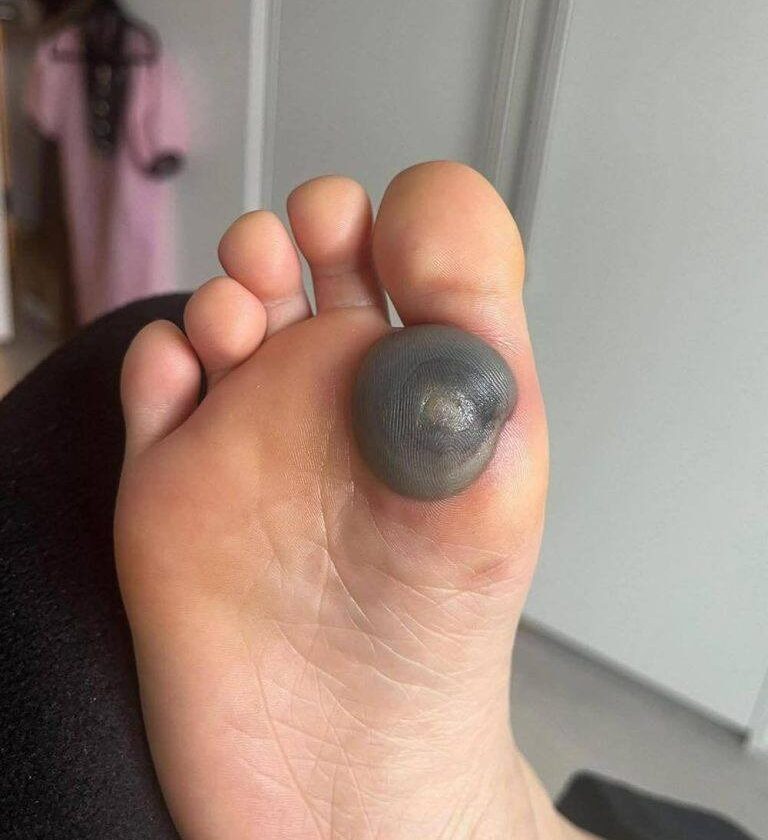
Here’s why this is urgent and what it could potentially be (so you can better inform the doctor):
Reasons This Needs a Doctor NOW:
Inability to Move the Foot: This indicates the problem is affecting more than just the skin’s surface—it could involve tendons, joints, nerves, or deep tissue. This is not typical for a simple superficial blister.
Severe Pain: Significant pain points to inflammation, infection, or pressure on nerves.
Rapid Onset & Large Size: A lesion that appears overnight and is “huge” needs professional evaluation to rule out serious causes.
Possible Causes a Doctor Will Investigate:
Severe Infection (Cellulitis/Abscess): A deep skin infection can cause a red, swollen, painful, and blistering area. The inability to move the foot is a classic sign that the infection may be spreading into deeper tissues. This is a medical emergency.
Trauma (Crush Injury): She may have injured her foot without realizing it (e.g., dropping something on it, a heavy door closing on it). This can cause deep bleeding under the skin that appears as a large, dark blister.
Blood Blister from Ill-Fitting Shoes: This is the most common cause, but the severe pain and immobility make a simple blister less likely. If it is a blister, it may be very deep or infected.
Insect/Spider Bite: Some bites (like from certain spiders) can cause severe local reactions with blistering, intense pain, and swelling that limits movement.
Underlying Medical Condition: In rarer cases, sudden blistering can be related to blood clotting issues or other conditions.
What to Do Until You See a Doctor:
Do NOT pop or drain the blister. You could introduce a serious infection.
Keep the foot elevated above heart level if possible. This can help reduce swelling and pain.
You can loosely cover it with a clean, dry bandage or gauze to protect it.
Give age-appropriate pain relief (like acetaminophen/Tylenol) if needed and she has no allergies to it, following package instructions. Do not give aspirin to children.
Do not apply any creams, ointments, or home remedies until a doctor has seen it.
At the Medical Appointment, Be Prepared to Tell the Doctor:
When it first appeared (this morning).
Her level of pain (scale of 1-10).
That she cannot move her foot.
Any recent injury, new shoes, or insect bites she may have had.
Any fever or other symptoms.
This is a situation where it is always better to err on the side of caution. Her inability to move her foot changes everything. Please seek professional medical evaluation without delay to get her the proper diagnosis and treatment, and to relieve her pain.