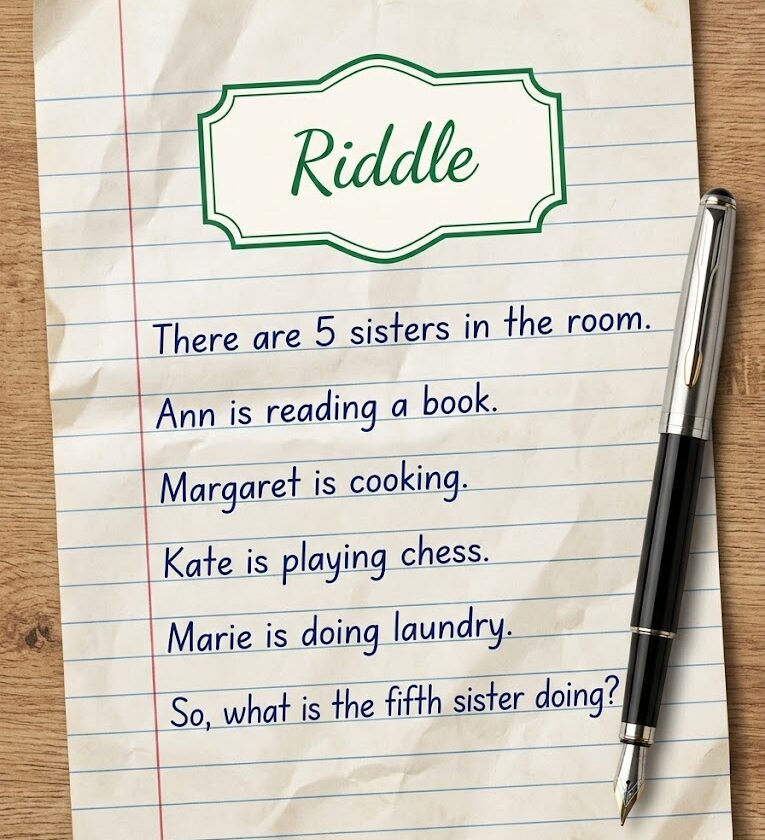
At first glance, this riddle seems incredibly simple. But surprisingly, most people get it wrong the first time they read it. Why? Because our brains love patterns and quick assumptions, and sometimes that leads us to miss the most obvious clue.
Riddles like this are popular across social media because they create that satisfying “wait… how did I miss that?” moment. They’re short, clever, and perfect for testing your observation skills.
Take a moment to read the scenario carefully and see if you can figure it out before looking at the answer.
🧠 The Riddle
Five sisters are each doing something different:
- Ann is reading
- Margaret is cooking
- Kate is playing chess
- Marie is doing laundry
Question: What is the fifth sister doing?
👀 Why This Riddle Tricks So Many People
When most people read the list, their brain immediately tries to assign a separate activity to each sister. It feels natural to assume every person must be doing something alone.
But here’s the detail many readers overlook:
👉 Chess is not a solo activity.
Your brain quickly processes the list and assumes independence between each action, but one of those activities actually requires another person.
That small assumption is what makes this riddle so effective.
💡 The Answer
The fifth sister is playing chess with Kate.
That’s it!
There are no hidden tricks or confusing wording. The answer was right there the entire time—just disguised by a simple assumption.
🧠 What Makes This Riddle So Clever
This riddle works because it takes advantage of common thinking habits:
- We assume everyone is doing something alone
- We skim instead of analyzing each detail
- We overlook simple real-world knowledge
Once you realize that chess requires two players, the solution suddenly becomes obvious.
That moment of realization is exactly what makes riddles like this so satisfying.
🎯 Why People Love Riddles Like This
Simple brain teasers have remained popular for generations because they combine fun, curiosity, and challenge in just a few sentences.
People enjoy them because they:
- Challenge logical thinking
- Improve observation skills
- Create that rewarding “aha!” moment
- Are easy to share with friends and family
They’re also perfect conversation starters in classrooms, group chats, or social media posts.
🤔 Final Thought
Sometimes the hardest puzzles aren’t the complicated ones. The real challenge is slowing down and noticing the small details we normally overlook.
The next time something seems confusing, take another look. The answer might not be hidden at all—it might simply be waiting for you to notice it.