Reading Time: 4 minutes
Category: Natural Food Tips / Healthy Living
Honey is often called “liquid gold,” but not every bottle on the grocery store shelf contains the real thing.
Because honey is so valuable and widely used, some manufacturers dilute it with sugar syrup, corn syrup, or other sweeteners. This has led many people to search for quick ways to check whether the honey they bought is pure or fake.
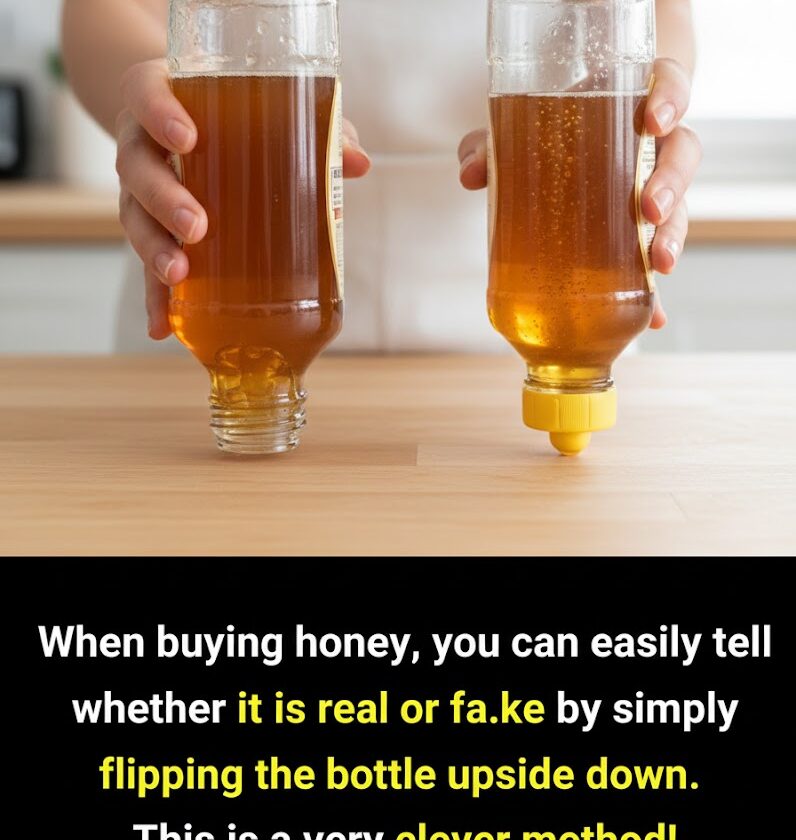
One popular trick spreading online is the “bottle flip test.” Supposedly, you can tell if honey is real simply by turning the bottle upside down.
But does this viral trick actually work?
Let’s break down the truth.
The Popular “Bottle Flip” Honey Test
If you’ve spent any time on social media, you’ve probably seen videos demonstrating this simple method.
The advice usually sounds like this:
“Flip the honey bottle upside down. If the bubble moves slowly, it’s real honey. If it flows quickly like water, it’s fake.”
It sounds like the perfect life hack because:
- It takes only seconds
- No tools are needed
- Anyone can try it in the grocery store
However, while the idea is based on how thick honey should be, the test is far from reliable.
What the Bottle Flip Test Claims
The logic behind the trick is based on viscosity, which means how thick a liquid is.
The Theory for Real Honey
Supporters of the test believe pure honey should behave like heavy syrup.
When the bottle is flipped:
- A large air bubble moves slowly toward the top
- The honey flows gradually due to its thickness
The Theory for Fake Honey
If honey has been diluted with sugar water or corn syrup, it becomes thinner.
In that case:
- The liquid flows quickly
- Air bubbles rise rapidly
This seems logical — but reality is more complicated.
Why the Bottle Flip Trick Can Be Misleading
Even though the idea makes sense, several factors can affect how honey behaves in a bottle.
1. Temperature Changes Everything
Honey reacts strongly to temperature.
When it’s warm, honey becomes much thinner.
When it’s cold, it becomes thicker and slower.
This means:
- Real honey in a warm kitchen may appear runny
- Cheap syrup in a cold pantry may look thick
Because of this, the flip test can easily give false results.
2. Processing Changes the Texture
Most honey sold in supermarkets is filtered and pasteurized.
This process heats the honey to remove crystals and extend shelf life.
As a result:
- Even 100% pure honey may appear thinner than raw honey
- The flip test may incorrectly suggest it’s fake
Raw honey, on the other hand, is usually thicker and cloudier.
3. Some Fake Honey Is Thick Too
Unfortunately, food fraud has become more sophisticated.
Manufacturers can blend fake honey with:
- High-fructose corn syrup
- Sugar syrups
- Thickening agents
These additives can mimic the same slow-moving bubble as real honey, completely fooling the flip test.
4. Bottle Shape Makes a Difference
The container itself can affect how the liquid moves.
For example:
- Narrow bottle necks slow the flow
- Wide openings allow faster movement
Even air pressure inside the bottle can change how quickly bubbles rise.
This means the test may say more about the bottle design than the honey inside.
Better Ways to Test Honey at Home
While no home test is perfect, some simple methods can give better clues about honey purity.
Using several tests together works best.
1. The Thumb Test
This quick method checks how much water is in the honey.
How to do it
- Place a small drop of honey on your thumb.
- Watch how it behaves.
Results
Real honey:
- Stays in place
- Keeps its shape
Fake or diluted honey:
- Spreads quickly
- Feels watery on the skin
2. The Water Test
This classic kitchen test shows how honey interacts with water.
How to do it
- Fill a glass with water.
- Add a spoonful of honey.
Results
Real honey:
- Sinks to the bottom
- Forms a lump before slowly dissolving
Fake honey:
- Dissolves quickly
- Disperses throughout the water
3. The Paper Towel Test
Pure honey contains very little moisture.
How to do it
- Place a small amount of honey on tissue paper or a paper towel.
Results
Real honey:
- Stays on top of the paper
- Does not soak through easily
Fake honey:
- Leaves a wet stain on the paper
- Soaks through quickly
How to Buy Real Honey
The best way to avoid fake honey is to choose wisely when shopping.
Here are a few simple tips.
Read the ingredient label
Look for 100% honey.
Avoid products containing:
- Glucose syrup
- Corn syrup
- Fructose
- “Honey blends”
Look for certifications
Quality honey may include labels such as:
- USDA Organic
- True Source Honey certification
- Country-of-origin seals
These indicate stricter sourcing standards.
Buy from local beekeepers
Local honey is often the most reliable option.
Buying directly from a beekeeper allows you to:
- Ask how the honey is harvested
- Learn whether it is raw or filtered
- Support local agriculture
The Bottom Line
The upside-down bottle trick is popular online, but it’s not a reliable way to test honey purity.
Honey thickness can change depending on:
- Temperature
- Processing methods
- Bottle design
- Flower sources visited by bees
While home tests can provide clues, the best approach is still buying from trusted sources and reading labels carefully.
Real honey is more than just a sweetener.
It’s a natural product created by bees, packed with flavor, nutrients, and centuries of tradition — truly deserving of its nickname: liquid gold.