The Stray Cat He Refused to Leave Behind
What makes this story so heartbreaking is that the man is never presented as a hero in the dramatic sense. He isn’t fearless. He isn’t powerful. He isn’t rescued at the last moment by some miracle that suddenly restores his life.
He is cold.
Exhausted.
Forgotten by most of the world.
And yet, even in that condition, he still chooses responsibility over comfort. Compassion over self-preservation.
That quiet decision is what makes the story unforgettable.
The emotional center of the story arrives in a single sentence:
“She chose me.”
To many people, a stray cat might seem insignificant compared to food, shelter, or survival. But loneliness changes the meaning of things. When someone loses stable housing, work, family contact, or the feeling that they belong anywhere, companionship becomes more than comfort.
It becomes proof that they still matter.
People often underestimate how deeply human beings need attachment. Once someone begins losing connections one by one, even a small bond can become emotionally life-saving. A pet is no longer “just an animal.” It becomes routine, responsibility, accountability, and unconditional presence in a world that may otherwise feel empty.
That’s why his refusal to abandon the cat doesn’t feel irrational.
To him, leaving her behind may have felt like abandoning the last loyal relationship he had left.
And suddenly the story becomes about much more than survival.
It becomes about dignity.
Why the Story Feels So Real
Part of what makes the piece emotionally powerful is its restraint. The man is not idealized or romanticized. He remains visibly vulnerable throughout the story. He is suffering physically, emotionally, and socially.
But despite all of that, kindness survives inside him.
That detail matters.
Hardship often changes people. Sometimes it creates bitterness. Sometimes it creates numbness. But sometimes—quietly—it reveals tenderness that comfort never required.
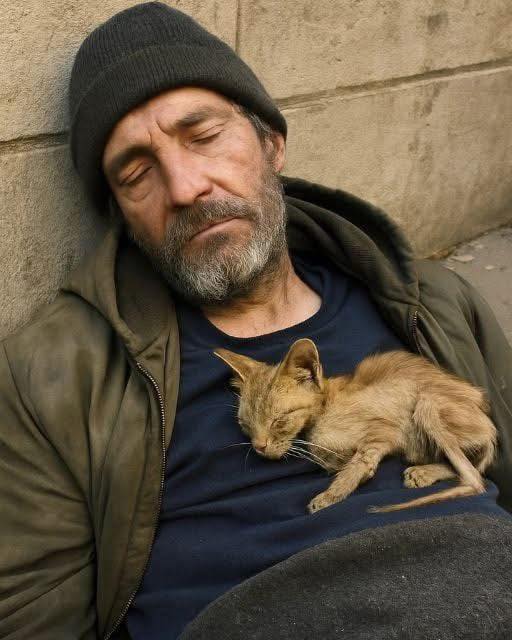
The image of him protecting the cat with bare, freezing hands says everything the story needs to say. Even while clearly suffering himself, his instinct remains focused outward:
Protect the smaller life.
Keep her warm.
Make sure she survives.
There is something deeply human about that kind of sacrifice because it asks for nothing in return.
The Meaning Behind “She Chose Me”
That single sentence carries enormous emotional weight because it reveals how desperately people need to feel seen.
To the outside world, the cat may have looked like another stray.
But to him, she represented trust.
Choice.
Connection.
In a life shaped by rejection and invisibility, the fact that another living creature stayed beside him mattered profoundly. The cat did not judge him for where he slept, what he owned, or what society thought of him.
She simply stayed.
And for someone carrying deep loneliness, that kind of loyalty can become emotionally essential.
Many people survive hardship not through logic alone, but through attachment. Through the feeling that someone—or something—still depends on them.
The cat gave him purpose.
And purpose can keep people emotionally alive long after hope begins fading.
The Quiet Criticism Hidden Inside the Story
The story also reveals something painful about systems designed to help vulnerable people.
The outreach workers and shelters are not necessarily cruel. Rules about animals often exist because of allergies, sanitation concerns, safety issues, or limited resources.
But reality becomes morally complicated when survival systems unintentionally force people to choose between physical safety and emotional survival.
Because human beings are not machines.
People do not survive on practicality alone.
Sometimes the very relationship that appears irrational from the outside is the thing holding a person together psychologically.
And the story understands that without turning anyone into a villain.
That nuance is part of what makes it feel honest.
Why the Ending Hurts So Much
The ending avoids dramatic explanation.
There is no emotional speech.
No detailed final scene.
No neat resolution.
Only absence.
A shape on the cold concrete.
Orange fur left behind.
Silence.
And somehow, that restraint makes the grief feel even heavier.
Often the deepest sadness does not come from witnessing tragedy directly. It comes from realizing how quietly people can disappear from public attention. How easily someone can fade from the world without headlines, memorials, or acknowledgment.
The story captures that painful truth with devastating simplicity.
A Story About Humanity, Not Homelessness Alone
What makes the story linger emotionally is that the man is never reduced to stereotypes.
He is not presented merely as a statistic.
Not as a social issue.
Not as a cautionary tale.
He remains fully human throughout the piece—capable of loyalty, gentleness, love, and moral clarity despite living in circumstances that could have hardened him completely.
The cat trusted him fully.
And perhaps that trust says more about his character than society ever did.
There is also something spiritually revealing about the fact that compassion survived inside him when comfort had not. A man with almost nothing still recognized another fragile life as precious and worth protecting.
That matters.
Because the story quietly reminds us of something easy to forget:
A person’s humanity is not measured by what they own, where they sleep, or how successful they appear from the outside.
Sometimes the clearest evidence of someone’s character appears precisely when life has taken almost everything else away.
And sometimes, the smallest act of loyalty becomes the final thing keeping a soul from disappearing completely.