🍉 Melon 3 — Probably Skip It
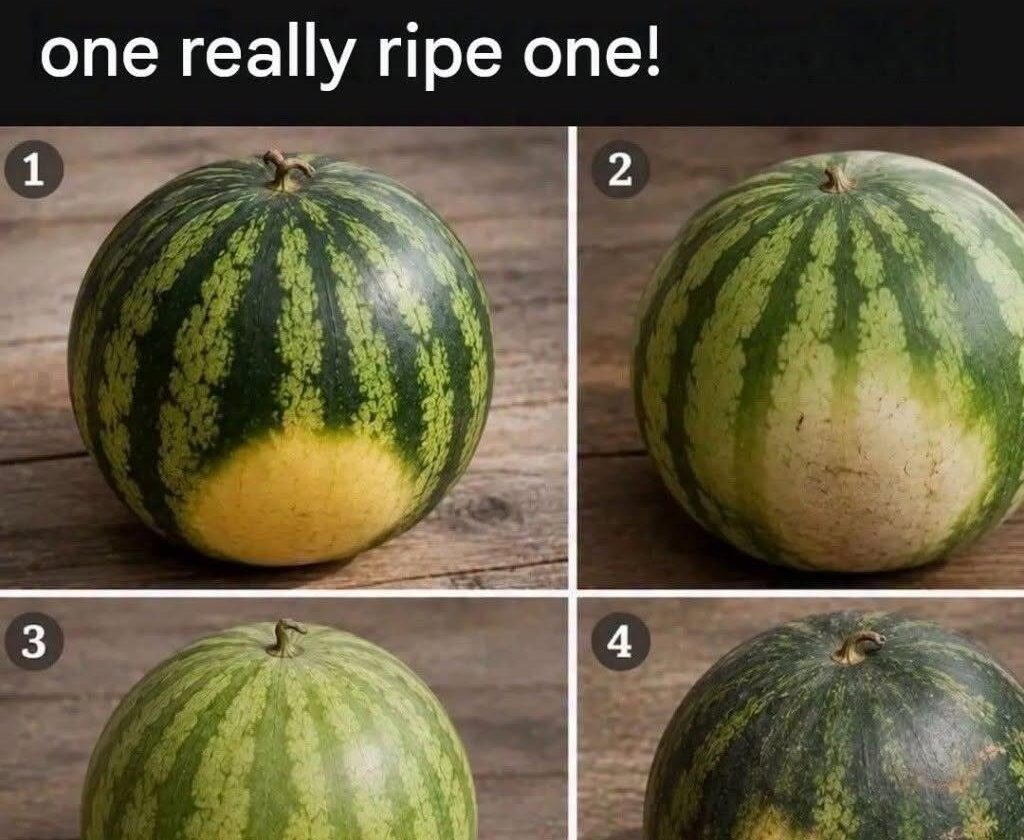
The third melon has lighter skin, less pronounced stripes, and a less intense yellow ground spot.
These characteristics may suggest that it was harvested at a different stage of maturity, although appearance alone cannot guarantee how sweet the inside will be.
If you’re choosing between several watermelons, there’s little reason to take a chance on the least promising-looking one.
Verdict: If better options are available, choose another watermelon.
🍉 Melon 4 — Here’s What to Look For
For the fourth melon, pay attention to the same characteristics:
- Ground spot: A creamy yellow or deeper yellow patch is generally more encouraging than a white or very pale one.
- Shape: Look for a symmetrical, well-developed watermelon without major irregularities.
- Skin: A healthy, mature-looking rind is preferable to one that appears unusually pale.
- Stem: A naturally dried stem can provide a useful clue, although it shouldn’t be used by itself to judge ripeness.
- Weight: Pick up comparable melons and choose one that feels heavy for its size, which can indicate good water content.
The Winner: Melon 1 🏆
When comparing the four, Melon 1 stands out as the strongest choice based on the visible characteristics described above.
But there’s an important point to remember: no single external sign can guarantee a perfectly sweet watermelon.
Watermelon sweetness depends on variety, growing conditions, harvest timing, and storage. Ground spots and other visual clues can help narrow down your options, but they aren’t a foolproof test.
How to Pick a Sweet Watermelon at the Grocery Store
If you’re standing in the produce section trying to decide which watermelon to buy, use this quick checklist:
1. Look for a developed ground spot
The ground spot is the area where the watermelon rested against the ground while growing.
A creamy yellow or yellow-orange spot is generally more encouraging than a very white or pale spot.
2. Compare the weight
Pick up two similarly sized watermelons.
The one that feels heavier for its size may contain more water and have a satisfying texture.
3. Choose a symmetrical shape
A watermelon with a relatively uniform, well-developed shape is often a better bet than one with major dents, irregularities, or unusual deformities.
4. Examine the rind
Look for a healthy-looking rind with a mature appearance. Extremely shiny or pale skin isn’t necessarily a sign of poor quality, but comparing several melons can help.
5. Check the stem when possible
A dry, brownish stem can indicate that the watermelon has reached maturity, although stem appearance isn’t a guarantee of sweetness.
A Common Watermelon-Picking Mistake
One of the biggest mistakes is choosing a watermelon simply because it looks large.
Bigger doesn’t automatically mean sweeter.
Instead, compare several fruits based on their overall appearance, weight, shape, and ground spot.
And don’t rely entirely on the popular idea that tapping a watermelon and listening for a particular sound will tell you whether it’s ripe. The sound can be difficult to interpret consistently, especially for shoppers without experience.
Final Verdict
If these four melons are your choices, Melon 1 is the clear winner based on the characteristics described.
🍉 #1 — Best choice: Melon 1
🍉 #2 — Decent alternative: Melon 2
🍉 #3 — Less promising: Melon 3
🍉 #4 — Compare carefully: Melon 4
The next time you’re shopping for watermelon, don’t just grab the biggest one. Look underneath, compare the ground spots, check the overall shape, and choose a melon that feels heavy for its size.