
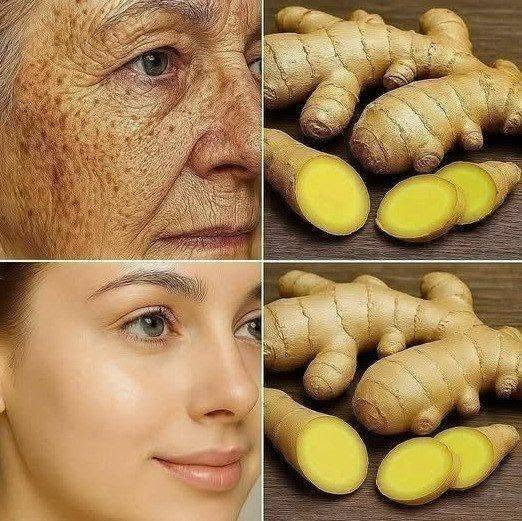
Ginger for Wrinkles and Dark Spots? Here’s What It Can—and Can’t—Really Do for Your Skin
You may have seen the claim all over social media: “Ginger is 100 times more effective than Botox and can erase deep wrinkles, freckles and discoloration.”
It sounds incredible. Ginger is inexpensive, natural and probably already sitting in your kitchen.
But before rubbing fresh ginger all over your face, there’s something important to know:
Ginger is not a natural replacement for Botox, and there is no good clinical evidence showing that it can erase deep wrinkles or permanently remove freckles.
That doesn’t mean ginger is useless. It contains some genuinely interesting compounds—but the realistic benefits are very different from the dramatic before-and-after pictures circulating online.
Why Ginger Became So Popular in DIY Skincare
Ginger contains bioactive compounds including gingerols and shogaols. These compounds have antioxidant and anti-inflammatory properties that have attracted considerable scientific interest.
Oxidative stress and inflammation are involved in skin aging, so it’s understandable why researchers are interested in plant-derived antioxidants.
But there’s a major difference between showing antioxidant activity in laboratory experiments and proving that putting ginger on someone’s face reverses decades of skin aging.
That’s where many viral claims go too far.
Can Ginger Really Remove Deep Wrinkles?
Not in the way these posts suggest.
Deep wrinkles develop through a combination of aging, repeated facial movement, sun exposure, changes in collagen and elastin, genetics, smoking and other environmental factors.
Ginger cannot simply erase those structural changes.
And comparing ginger with Botox is particularly misleading.
Botulinum toxin treatments temporarily reduce activity in specific facial muscles responsible for certain expression lines. Ginger doesn’t work through that mechanism.
So there is no meaningful scientific basis for saying ginger is “100 times stronger than Botox.”
What About Freckles and Dark Spots?
This is another area where expectations need to be realistic.
Freckles are related largely to genetics and exposure to ultraviolet radiation. Other dark spots can result from sun damage, inflammation, hormonal changes or other skin conditions.
Some laboratory research has investigated ginger-derived compounds and pigmentation pathways, but that doesn’t establish raw ginger as an effective treatment for freckles or hyperpigmentation.
More importantly, not every dark mark is the same thing.
A freckle, post-acne mark, melasma and changing pigmented lesion may require completely different approaches.
The Biggest Problem With the Viral “Ginger Recipe”
Natural doesn’t automatically mean gentle.
Fresh ginger contains potent compounds that can irritate skin.
Applying concentrated ginger juice, ginger paste or ginger essential oil directly to the face may cause burning, redness, itching or contact dermatitis, particularly in people with sensitive skin.
Mixing it with other popular DIY ingredients can make matters worse.
Recipes containing lemon juice are especially questionable because acidic citrus juice can irritate skin, and certain citrus compounds combined with sunlight can trigger troublesome skin reactions.
Baking soda is another ingredient I’d avoid using as a facial treatment. It’s alkaline and can disrupt the skin barrier.
And concentrated essential oils shouldn’t simply be rubbed onto facial skin undiluted.
If You Still Want to Try Ginger on Your Skin
Keep expectations modest and prioritize avoiding irritation.
A commercially formulated skincare product containing ginger extract is generally more predictable than rubbing raw ginger onto your face because reputable cosmetic formulations control concentration and other ingredients.
If you’re trying any new topical product, test a small area first and stop using it if you develop burning, persistent redness, swelling or significant itching.
Don’t apply DIY ginger mixtures around the eyes or to irritated, broken or freshly treated skin.
What Actually Helps Prevent Premature Skin Aging?
One of the most effective things isn’t exotic at all:
Sun protection.
Ultraviolet exposure contributes substantially to premature skin aging and pigmentation.
Using broad-spectrum sunscreen, seeking shade during intense sunlight and avoiding intentional tanning can help prevent additional discoloration and photoaging.
For existing fine lines, ingredients such as retinoids have substantially more evidence behind them than raw ginger. Depending on the pigmentation problem, dermatologists may also use ingredients such as azelaic acid, vitamin C, retinoids or other targeted treatments.
Procedures can be considered for deeper wrinkles or persistent pigmentation, but the appropriate option depends on the person’s skin and the specific problem being treated.
Don’t Try to “Burn Off” a Dark Spot
This deserves special attention.
If you have a new or changing dark spot, don’t repeatedly attack it with ginger, lemon, vinegar, hydrogen peroxide or another harsh home remedy.
A pigmented lesion that is changing in size, shape or color, has irregular borders, repeatedly bleeds, becomes persistently irritated, or simply looks noticeably different from your other spots should be evaluated by a healthcare professional.
Trying to remove it at home can irritate the area and delay proper assessment.
So Is Ginger Good for Your Skin?
Potentially—as an ingredient, not as a miracle cure.
Ginger contains biologically active antioxidant and anti-inflammatory compounds, which helps explain why it appears in some cosmetic formulations and why researchers continue studying it.
But that’s very different from claiming:
“Rub ginger on your face and deep wrinkles disappear.”
Or:
“Ginger works 100 times better than Botox.”
Those claims aren’t supported by good clinical evidence.
The dramatic transformation shown in viral before-and-after images shouldn’t be treated as proof that ginger produced the result. Lighting, makeup, editing, different subjects and other treatments can radically alter how skin looks in photographs.
The more realistic message is much simpler:
Ginger may be an interesting skincare ingredient, but it cannot be expected to erase deep wrinkles, freckles or years of sun damage.