
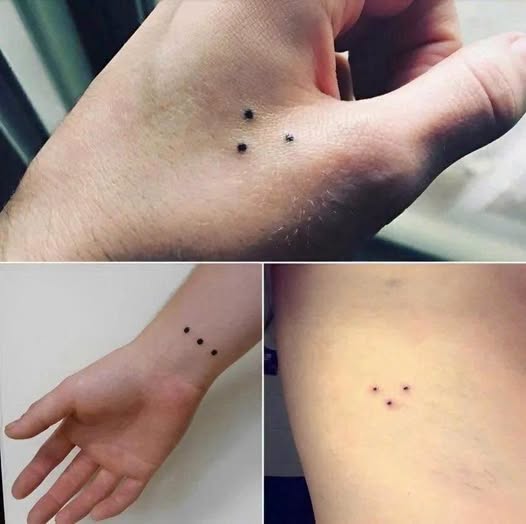
The Truth About the Three-Dot Tattoo: What It Really Means and Why Context Matters
Subtitle: A tiny tattoo often surrounded by fear and rumors may have far more meanings than most people realize.
The warning spreads quickly online:
“If you see someone with a three-dot tattoo, stay away.”
It’s the kind of statement designed to spark fear instantly. Short. Urgent. Memorable.
But reality is rarely that simple.
A tattoo—especially one as small as three dots—cannot tell you everything about a person’s life, values, or intentions. Symbols often carry multiple meanings, and the three-dot tattoo is one of the clearest examples of how assumptions can lead to misunderstanding.
For some people, those dots represent hardship and survival. For others, they symbolize family, faith, balance, or personal growth. In certain situations, the tattoo has been associated with criminal groups, but context is essential.
The truth is that a tattoo alone cannot define a person’s character.
Why the Three-Dot Tattoo Gets So Much Attention
Few tattoos create as much curiosity as three simple dots.
Part of the reason is their simplicity. They can be placed almost anywhere:
- On the hand
- Near the eye
- On the wrist
- Between fingers
- Behind the ear
- On the arm or ankle
Because the design is minimal, many people assume it must have a hidden meaning.
Sometimes it does.
Sometimes it doesn’t.
And that’s exactly why assumptions can be misleading.
The Meaning of “Mi Vida Loca”
One of the most widely recognized interpretations of the three-dot tattoo is the phrase:
Mi Vida Loca
(“My Crazy Life”)
In some communities, the three dots symbolize a difficult life filled with hardship, struggle, or survival.
Importantly, the phrase does not automatically indicate gang membership.
For many individuals, it represents:
- Overcoming adversity
- Surviving difficult experiences
- Personal resilience
- A reminder of where they came from
- Growth through hardship
Just as people wear tattoos honoring battles they have survived, some use the three dots as a symbol of endurance rather than danger.
Family and Personal Meanings
Many tattoos are deeply personal.
Three dots may symbolize:
- Three children
- Three siblings
- Three generations
- Three important people
- Past, present, and future
- Mind, body, and spirit
In these cases, the tattoo has nothing to do with crime or violence.
Instead, it serves as a permanent reminder of love, identity, or personal milestones.
Spiritual and Religious Interpretations
For others, the number three holds spiritual significance.
Different cultures and religions attach meaning to the number in various ways, including:
- The Holy Trinity
- Birth, life, and death
- Faith, hope, and love
- Balance and harmony
- Body, mind, and soul
Minimalist tattoos have become increasingly popular, and three dots can be a subtle way to represent beliefs without elaborate artwork.
Can the Three-Dot Tattoo Be Gang Related?
Yes.
In some contexts, the three-dot tattoo has been associated with certain gangs or criminal lifestyles.
However, context is critical.
Law enforcement agencies and criminology experts consistently emphasize that a tattoo alone cannot determine gang affiliation.
Many factors matter, including:
- Location of the tattoo
- Accompanying symbols
- Personal history
- Behavior
- Self-identification
- Cultural context
Two people may have identical tattoos with completely different meanings.
That is why experts avoid drawing conclusions based solely on appearance.
Why Judging Tattoos Can Be Harmful
Humans naturally make quick judgments.
But appearances rarely tell the full story.
Assuming someone’s intentions, morality, or character based only on a tattoo can lead to:
- Stereotyping
- Discrimination
- Misunderstanding
- Fear based on misinformation
- Unfair treatment
A tattoo is an expression.
Character is demonstrated through actions.
Those are not the same thing.
The Importance of Context
Symbols gain meaning from the people who wear them.
The same image can represent:
- Love
- Loss
- Faith
- Survival
- Family
- Art
- Identity
- Culture
- Personal experiences
Without context, we only see the surface.
Understanding requires conversation, empathy, and curiosity.
Should You Be Concerned If Someone Has a Three-Dot Tattoo?
Not necessarily.
A tattoo alone is not evidence that someone is dangerous.
Behavior, actions, and choices provide far more information about who a person is than a small symbol ever could.
If someone has a three-dot tattoo, the most accurate assumption is often this:
You don’t know its meaning unless they tell you.
Frequently Asked Questions
Does a three-dot tattoo always mean gang affiliation?
No. It has multiple meanings, including personal, spiritual, cultural, and family-related interpretations.
What does “mi vida loca” mean?
It translates from Spanish as “my crazy life.” For many people, it symbolizes hardship, resilience, or overcoming difficult circumstances.
Can three dots represent family?
Yes. Some people use the tattoo to represent children, loved ones, or important relationships.
Is it wrong to ask someone what their tattoo means?
Not necessarily. Respectful curiosity is often better than making assumptions.
Can two identical tattoos have different meanings?
Absolutely. Tattoos are deeply personal, and identical symbols may represent entirely different experiences for different individuals.
You May Also Like
- The Hidden Meanings Behind Popular Tattoos
- Why People Get Memorial Tattoos
- The Psychology of Tattoos and Self-Expression
- Symbols That Mean Strength and Resilience
- Minimalist Tattoo Trends Explained
- How Different Cultures Interpret Common Symbols
Final Thoughts
The three-dot tattoo is a powerful reminder that symbols rarely tell a complete story.
For some people, it represents survival.
For others, it symbolizes family, faith, or personal growth.
And yes, in certain contexts, it may carry criminal associations.
But context matters.
A tattoo does not determine a person’s character, values, or intentions.
People are more complex than symbols.
Before assuming the worst, it is worth remembering that meaning does not live in the tattoo itself—it lives in the person who chose to wear it.