
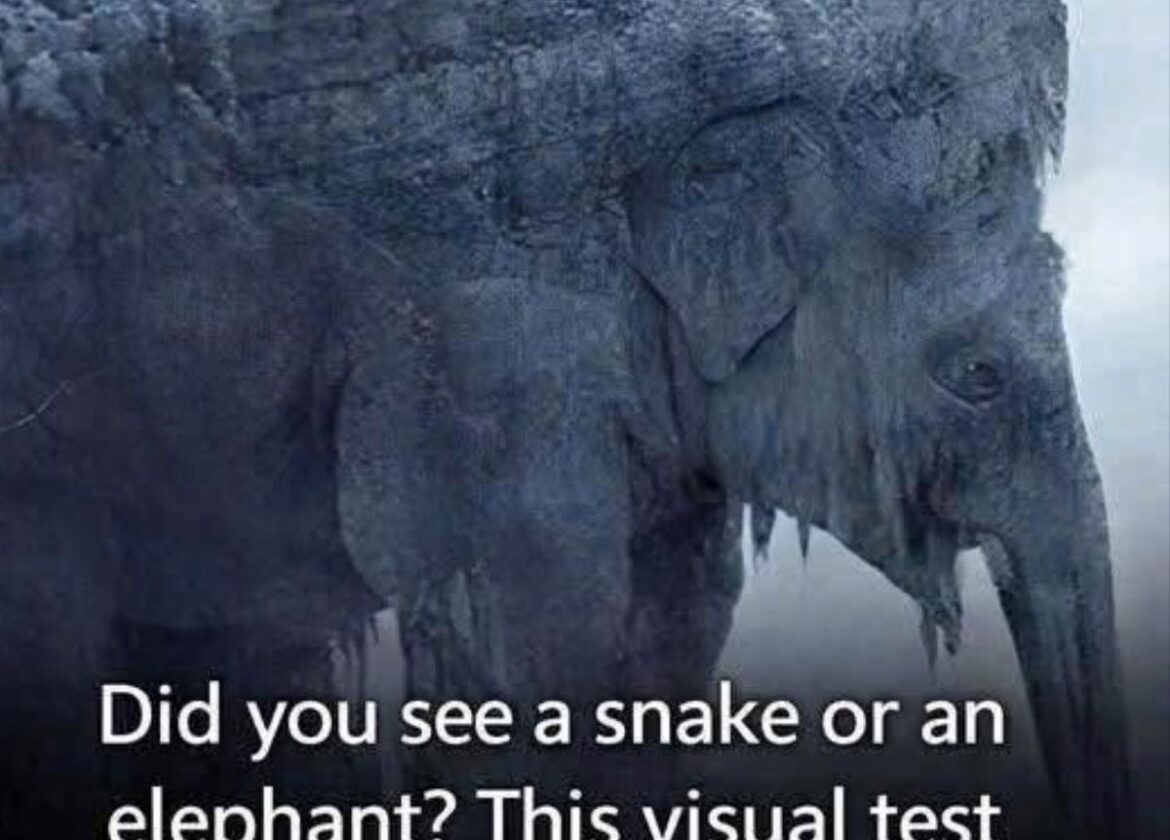
What Do You See First: A Snake or an Elephant?
A fascinating optical illusion is capturing attention online and sparking friendly debates among viewers.
At first glance, the image appears to show an icy rock formation covered in snow. But look more carefully, and a second image begins to emerge.
Some people immediately notice a snake-like shape winding across the scene. Others instantly spot the profile of an elephant hidden within the frozen landscape.
So, what did you see first?
While viral posts often claim your answer reveals hidden aspects of your personality, it’s important to remember that these interpretations are meant for fun rather than scientific analysis. Still, the illusion offers an interesting glimpse into how differently people can perceive the exact same image.
Why Optical Illusions Fascinate Us
Optical illusions challenge the way our brains process visual information.
Rather than simply recording what our eyes see, our brains constantly interpret shapes, patterns, shadows, and contrasts to create meaning. When an image contains multiple possible interpretations, different people may notice different things first.
This particular illusion uses contrast and overlapping shapes to create two distinct images within the same scene. The lines that form the snake can also contribute to the shape of the elephant, making the image a perfect example of ambiguous perception.
If You Saw the Snake First
People who notice the snake first are often described as attentive to details and quick to recognize subtle patterns.
You may enjoy analyzing situations carefully before making decisions and prefer to understand potential risks before moving forward.
Common traits often associated with this interpretation include:
- Observant and detail-oriented
- Thoughtful and analytical
- Careful when making decisions
- Good at spotting problems others overlook
Of course, these descriptions are intended as lighthearted entertainment rather than psychological facts.
If You Saw the Elephant First
Those who immediately notice the elephant are often described as big-picture thinkers.
Rather than focusing on small details, you may naturally look for overall patterns, possibilities, and long-term outcomes.
Traits commonly linked to this interpretation include:
- Creative and imaginative
- Optimistic about future possibilities
- Comfortable with uncertainty
- Strong at seeing connections between ideas
Again, these interpretations are simply part of the fun and should not be taken as scientific conclusions.
If You Saw Both Images
Some viewers quickly switch between the snake and the elephant.
If that happened to you, it may suggest a flexible style of thinking. You may enjoy considering multiple perspectives before reaching conclusions and feel comfortable adapting when situations change.
People often associate this response with:
- Open-mindedness
- Curiosity
- Adaptability
- Strong problem-solving skills
What Science Actually Says
Researchers study optical illusions because they reveal how perception works.
Factors such as attention, expectations, previous experiences, and even current mood can influence what a person notices first. However, there is no evidence that seeing one image before another can accurately determine someone’s personality or predict future behavior.
The real value of illusions lies in demonstrating how differently our brains can interpret the same information.
A Fun Reminder About Perspective
Whether you saw the snake, the elephant, both, or neither, the illusion highlights an important truth: perception is not always objective.
Two people can look at the same image and have completely different experiences.
That’s part of what makes optical illusions so enjoyable. They remind us to stay curious, consider alternative viewpoints, and appreciate how uniquely each person sees the world.
So, what did you see first—the snake or the elephant?