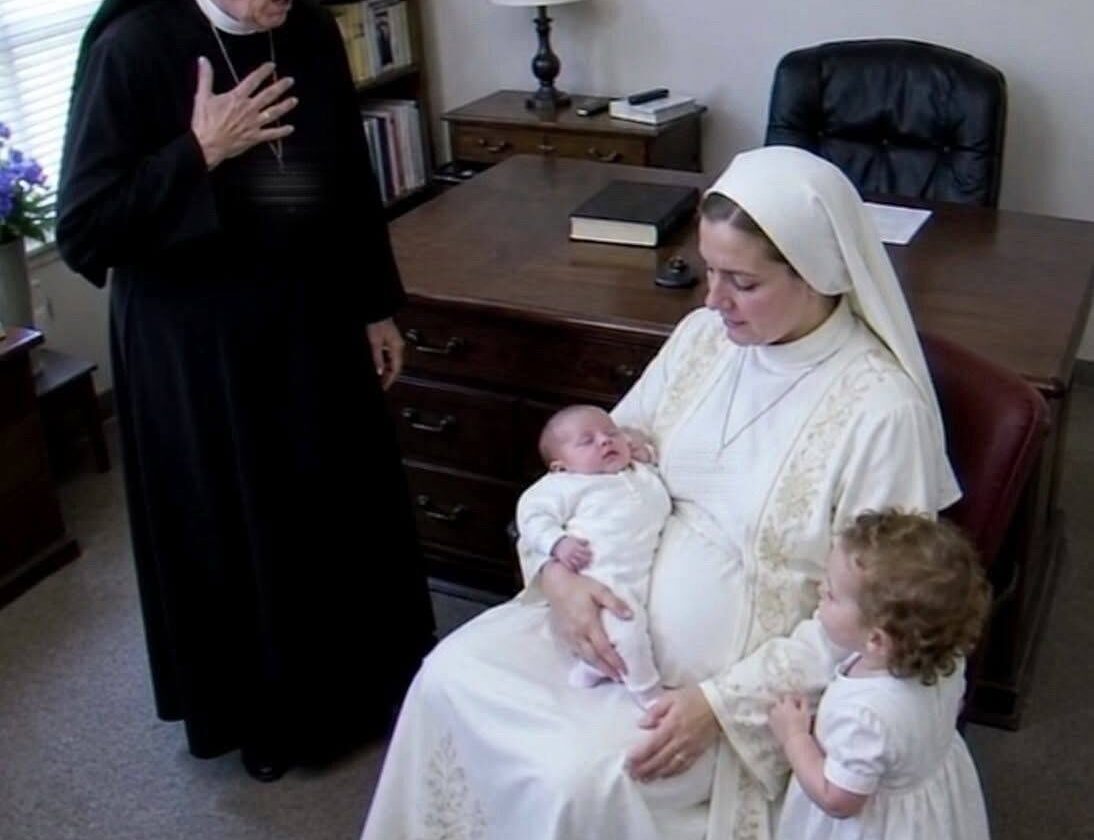
Doctor Paloma Arrives at the Convent
Doctor Paloma arrived before ten.
Her gray motorcar stopped just beyond the convent gate, and Sister Beatriz hurried to admit her.
The doctor stepped inside carrying a black medical case, her hair pinned beneath a simple hat.
Mother Caridad waited in the entry hall.
“You came quickly.”
“You sounded worried.”
“I am worried.”
Paloma removed her gloves.
“Where is Esperanza?”
“In the kitchen with the children.”
“May I examine her in the infirmary?”
Mother Caridad nodded.
As they walked through the convent, the doctor’s gaze moved carefully over the corridors.
She glanced at the locked linen room, the chapel passage, and the narrow staircase leading toward the unused guest quarters.
Mother Caridad noticed.
“You are looking for something.”
“I am remembering the layout.”
“You have visited us for eleven years.”
“I know.”
They reached the infirmary door.
Mother Caridad took the handkerchief from her pocket and unfolded it.
The strip of tape lay in the center.
Doctor Paloma stared at it.
“Is it yours?” Mother Caridad asked.
“It is ordinary surgical tape.”
“That was not my question.”
Paloma’s eyes lifted.
“It could have come from my case during an earlier visit.”
“It was fresh.”
“How can you be certain?”
“It still had adhesive on it.”
The doctor pressed her lips together.
“Mother Caridad, let me examine Esperanza before we create explanations from scraps.”
“Very well.”
But as Paloma reached for the door, Mother Caridad stopped her.
“I have trusted you with the health of every woman in this convent.”
The doctor’s hand remained on the latch.
“I know.”
“I would like to continue doing so.”
Paloma turned.
There was no anger in her face.
Only sadness.
“You may find,” she said softly, “that trust and complete knowledge are not always the same thing.”
Before Mother Caridad could respond, footsteps approached.
Sister Esperanza appeared with Lucía.
Miguel slept in a cloth cradle against Lucía’s chest while Tomás held her hand.
Esperanza looked from the doctor to Mother Caridad.
“You came quickly.”
“I wanted to make sure you were well,” Paloma said.
She opened the infirmary door.
“Shall we?”
The Pregnancy Test Changes Everything
The examination was gentle and brief.
Doctor Paloma asked Esperanza a series of questions, checked her pulse, and carefully examined her abdomen.
Then she opened a small leather pouch and prepared a test.
Mother Caridad stood by the window.
Sister Lucía waited outside with the children.
Esperanza sat on the edge of the narrow bed, watching the doctor’s hands.
“You seem tired,” Paloma said.
“I have two little ones.”
“That would explain much of it.”
“Will there be a third?”
“We will know soon.”
Esperanza studied her.
“You already know.”
Paloma paused.
“What makes you say that?”
“The way you looked when you entered.”
“That is not a medical sign.”
“No,” Esperanza said. “It is a human one.”
The doctor placed the test aside and met her gaze.
“You have become more observant.”
“I have had reason to.”
Mother Caridad turned from the window.
“Esperanza, is there something you wish to tell us?”
The young nun folded her hands.
“I remember pieces of things.”
Doctor Paloma went still.
“What things?”
“A room. A light. Sometimes a voice. I think it may be yours.”
The doctor closed her case halfway, then opened it again.
“Memories can become confused during periods of illness.”
“Was I ill?”
“You have fainted more than once.”
“Before my first pregnancy?”
Paloma did not respond.
Mother Caridad stepped closer.
“Doctor?”
Paloma glanced at the test.
“It is positive.”
The room became completely silent.
Esperanza lowered her eyes.
Although she had expected the answer, hearing it confirmed seemed to drain the remaining strength from her body.
Her shoulders fell slightly.
Mother Caridad moved toward her.
“Are you unwell?”
“No.”
Esperanza’s voice trembled.
“I am only tired of being surprised by my own life.”
Mother Caridad sat beside her and took her hand.
For a moment, the mystery disappeared behind something simpler:
A young woman who had carried more uncertainty than anyone should have been asked to bear alone.
“We will find the truth,” Mother Caridad promised.
Esperanza looked at her.
“Will we still call it truth if it changes what we believe about one another?”
Mother Caridad tightened her hand around hers.
“Yes.”
Doctor Paloma turned away and began placing her instruments back into the case.
The click of each metal clasp sounded unusually loud.
Mother Caridad watched her.
“Paloma, we need to speak privately.”
“I expected that.”
Esperanza rose.
“No.”
Both women looked at her.
She stood unsteadily but with determination.
“If this concerns me, I will remain.”
“It may be difficult,” Paloma said.
“That does not make it less mine.”
Mother Caridad saw something new in Esperanza’s face.
The softness was still there.
But beneath it was a firmness that motherhood had perhaps given her.
“Very well,” Mother Caridad said. “You will stay.”
Paloma closed her eyes for a moment.
Then she pulled the single wooden chair away from the wall and sat down.
“This did not begin three years ago,” she said.
At first, neither Mother Caridad nor Esperanza spoke.
Outside, Tomás laughed at something Sister Lucía had said.
The sound drifted beneath the door, light and innocent.
Doctor Paloma placed both hands over the handle of her medical case.
“Six years ago,” she began, “before Esperanza took her final vows, she became seriously ill.”
The Name Esperanza Had Forgotten
Esperanza frowned.
“I do not remember that.”
“I know.”
Mother Caridad looked sharply at the doctor.
“What illness?”
“Severe anemia, fever, and exhaustion. She had been caring for Sister Magdalena during the influenza outbreak. Esperanza refused to rest. One night, she collapsed near the chapel.”
Mother Caridad searched her memory.
“I remember an illness, but not that it was so serious.”
“You were away at the diocesan meeting. Mother Inés was still alive then.”
The name changed the atmosphere in the room.
Mother Inés had led the convent before Caridad. She had been disciplined, private, and deeply respected. She had died five years earlier after a brief illness and was buried in the small cemetery beyond the orchard.
Mother Caridad’s expression hardened with concentration.
“What did Mother Inés do?”
“She asked me to treat Esperanza here.”
“That is ordinary.”
“Not entirely.”
Paloma looked at Esperanza.
“During your fever, you spoke about your family.”
“My family?”
“You said you had a sister.”
Esperanza’s face changed.
“I had a sister?”
“You have a sister,” Paloma corrected gently. “At least, you did six years ago.”
Esperanza stood so suddenly that the bed frame creaked.
“That cannot be true.”
“Sit down,” Mother Caridad said softly.
“No. My parents died when I was young. I was raised by my aunt. I was told I had no brothers or sisters.”
“Who told you that?” Paloma asked.
“My aunt.”
“What was her name?”
“Rosa Valdés.”
Paloma nodded slowly.
“Rosa was not your aunt.”
Esperanza stared at her.
Mother Caridad rose.
“Explain.”
“She was your mother’s cousin. After your parents died, you and your younger sister were separated. Rosa took you. Another relative took the younger child.”
Esperanza pressed a hand to her mouth.
“Why would no one tell me?”
“I cannot answer that.”
“But you knew?”
“Not at first. During your fever, you repeated a name—Elena. Mother Inés recognized it.”
Mother Caridad’s eyes narrowed.
“How?”
“Because Elena had written to the convent.”
The doctor opened a side compartment in her case and removed a folded sheet of paper.
It was old, worn at the creases, and sealed inside a transparent protective sleeve.
She held it out.
Mother Caridad accepted it but did not open it.
“You have carried this with you?”
“For years.”
“Why?”
“Because Mother Inés made me promise not to give it to Esperanza unless certain circumstances arose.”
Esperanza’s voice was barely audible.
“What circumstances?”
Paloma looked at her.
“If you began to remember.”
The young nun slowly sat down again.
Mother Caridad unfolded the paper.
The handwriting was uneven, as though the writer had paused often.
Dear Ana,
I do not know whether they still call you by that name. I have been told you entered the convent and may never wish to hear from the life you had before. I will respect that if it is your choice, but I need you to know that I am alive.
My name is Elena, and I believe I am your sister.
I have spent years searching for you. I found Rosa only after she became ill. She admitted that we were separated after our parents died because neither household could afford two children.
She said she told you I had died because she feared you would leave her to find me.
I do not blame you for not searching. You did not know.
I am married now. My husband is named Gabriel. We have tried to have children, but the doctors say it may not happen for us.
Still, my reason for writing is not to ask anything from you. I only want the chance to meet you once and tell you that you were never alone in the world.
Your sister,
Elena
Mother Caridad lowered the letter.
Esperanza looked as though the floor had shifted beneath her.
“My name was Ana?”
“Yes,” Paloma said.
“Why do I not remember her?”
“You were very young when you were separated. Perhaps four or five.”
“Did I meet her after she wrote?”
Paloma hesitated.
“Yes.”
Mother Caridad’s head lifted sharply.
“When?”
“During the weeks after your illness.”
“Inside the convent?”
“In the old guest parlor.”
Mother Caridad felt anger rising, but she kept her voice controlled.
“I was never told.”
“Mother Inés believed it should remain private until Esperanza decided what she wanted.”
Esperanza gripped the edge of the bed.
“What did I decide?”
The doctor’s face softened.
“You wanted to help her.”
“With what?”
Paloma did not answer immediately.
And in that silence, Mother Caridad understood why the medical tape had frightened her.
She looked at Esperanza.
Then at the positive pregnancy test on the tray.
“Her sister could not have children,” she said slowly.
Paloma nodded.
Esperanza stared between them.
“No.”
“Esperanza—”
“No,” she repeated.
There was no anger in the word.
Only disbelief.
“You are saying that I agreed to carry a child for someone else?”
“You agreed to consider it.”
“The children are Elena’s?”
“Biologically, that was the intention.”
The words hung heavily in the room.
From the corridor came the soft murmur of Sister Lucía singing to Miguel.
Esperanza looked toward the door.
“Intention?”
Doctor Paloma lowered her gaze.
“The first procedure was performed six years ago.”
The First Secret Was Only the Beginning
Mother Caridad blinked.
“Six years?”
“It was unsuccessful.”
Esperanza’s fingers trembled.
“I remember nothing.”
“You became frightened afterward,” Paloma explained. “Not because anyone forced you. Because you were uncertain whether your decision had come from love, guilt, or the fevered need to repair a family you had just discovered.”
Mother Caridad stepped forward.
“Then it should have ended.”
“It did.”
“But the pregnancies began three years later.”
“Yes.”
“How?”
Paloma reached into her case once more and removed a small notebook bound in dark leather.
It was not a medical record.
Its pages were filled with dates, initials, and brief handwritten entries.
“Mother Inés kept this,” Paloma said. “After her death, I found it among the records she asked me to preserve.”
Mother Caridad did not take the notebook.
“You are avoiding the answer.”
“I am trying to give it in the right order.”
“Then stop arranging the truth as though you own it.”
Paloma flinched.
Esperanza looked at Mother Caridad.
“Please.”
The older nun fell silent.
Doctor Paloma opened the notebook.
“After the first attempt failed, Elena and Gabriel left the region. They wrote several times. Esperanza answered twice.”
“I wrote to her?”
“Yes.”
“Do you have the letters?”
“No. But Mother Inés copied a line from one of them.”
Paloma read from the page.
“I cannot promise you a child, but I do not want fear to decide whether we remain sisters.”
Esperanza closed her eyes.
The sentence seemed to unlock something buried deep inside her memory.
A table.
A blue envelope.
Rain on glass.
Her own hand shaking as she wrote.
“I remember the ink,” she whispered.
Paloma leaned forward.
“What color?”
“Blue.”
The doctor nodded.
“You are remembering.”
Esperanza pressed her fingertips to her temples.
“There was a woman across from me. She had my eyes.”
“Elena.”
“She was crying.”
“Yes.”
“But she was not asking me for a baby.”
“No.”
“She said…”
Esperanza struggled.
Then she opened her eyes.
“She said she had spent too many years wanting a sister to risk losing one over a child.”
Doctor Paloma’s face filled with relief.
“That is what she said.”
Mother Caridad looked from one woman to the other.
“Then how did Esperanza become pregnant?”
Paloma closed the notebook.
“That is what I do not fully understand.”
The three women remained in the infirmary for nearly an hour.
Doctor Paloma explained that the first medical procedure had taken place with Esperanza’s written consent, witnessed by Mother Inés and an independent physician from the city.
Because of Esperanza’s illness and later distress, the documents had been sealed.
No further attempt was supposed to occur without her renewed agreement.
Yet three years later, Esperanza had become pregnant with Tomás.
Tests performed after his birth suggested he was related to Esperanza.
But Paloma had never been allowed to complete further testing.
“Allowed by whom?” Mother Caridad asked.
“Mother Inés was already dead. The diocesan administrator advised discretion.”
“Discretion is not an answer.”
“No,” Paloma said quietly.
“It is often the place where answers are buried.”
At that exact moment, Miguel began to fuss in the corridor.
Esperanza turned toward the sound.
And for one brief second, another memory flashed through her mind.
A blue envelope.
A woman’s trembling hands.
A locked door.
And a voice whispering:
“Do not let them take him.”
Esperanza froze.
Mother Caridad saw the color leave her face.
“Esperanza?”
She looked toward the door.
“I remember something else.”
Doctor Paloma slowly stood.
“What?”
Esperanza’s lips parted.
But before she could answer, someone knocked three times on the infirmary door.
Not Sister Lucía.
Not Sister Beatriz.
Three slow, deliberate knocks.
Mother Caridad looked at Doctor Paloma.
Paloma’s face had gone completely pale.
Because she knew that knock.
And whoever was standing on the other side of the door was not supposed to know Esperanza was beginning to remember.