
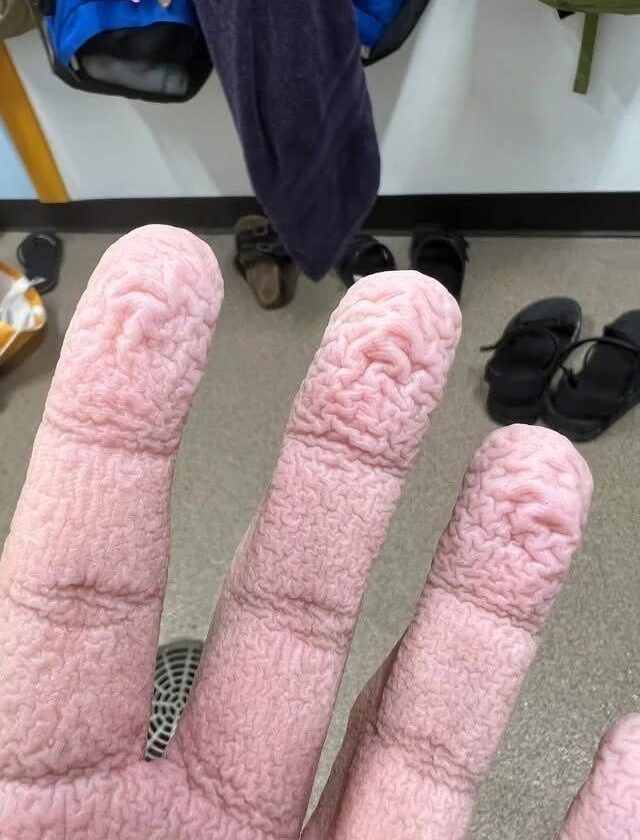
Why Your Fingers Wrinkle in Water: The Surprising Science Behind This Everyday Mystery
Subtitle: Ever noticed your fingertips becoming wrinkly after a long bath or while washing dishes? It might seem like your skin is simply soaking up water, but scientists have discovered something much more fascinating. Those tiny wrinkles are actually a clever response controlled by your nervous system.
I remember the first time I really paid attention to my wrinkled fingers.
I was washing dishes after making dinner when I glanced down at my hands. After just a few minutes in warm water, my fingertips had transformed into tiny ridges and folds that looked like dried prunes.
For years, I assumed my skin was simply absorbing water.
As it turns out, that explanation isn’t correct at all.
Researchers have found that finger wrinkling is an active biological process controlled by your nervous system—and it may even be an evolutionary adaptation that helped our ancestors survive.
Why Do Fingers Wrinkle in Water?
Contrary to popular belief, your skin isn’t just swelling with water.
Instead, when your hands stay submerged for several minutes, your autonomic nervous system triggers tiny blood vessels beneath the skin to narrow, a process known as vasoconstriction.
As these blood vessels constrict, the volume beneath the skin decreases slightly. This causes the skin to pull inward, creating the familiar wrinkles on your fingertips and toes.
In other words, your brain is actively creating those wrinkles.
The Science Behind Water-Wrinkled Fingers
Scientists have discovered several interesting facts:
- The process is controlled by the nervous system—not by water soaking into the skin.
- Small blood vessels beneath the skin tighten during prolonged water exposure.
- The reduced volume beneath the skin creates folds and ridges.
- The response usually begins after about 5 to 10 minutes in water.
- Once your hands dry, the wrinkles gradually disappear.
Interestingly, people with certain types of nerve damage often do not develop these wrinkles, which is one reason doctors sometimes use the response as part of neurological evaluations.
An Evolutionary Advantage
Why would humans evolve this unusual ability?
Researchers believe wrinkled fingertips improve our grip on wet objects.
Think about trying to pick up:
- Wet dishes
- Smooth rocks
- Fish
- Slippery tools
The wrinkles may function much like the tread on a tire, helping channel water away and improving friction.
Several scientific studies have found that people often handle wet objects more efficiently with wrinkled fingers than with smooth skin.
While researchers continue studying this theory, it remains one of the leading explanations.
What Wrinkled Fingers Are Not
Many common myths about wrinkled fingers simply aren’t true.
Water wrinkles are not:
- A sign of dehydration
- A symptom of aging
- Evidence that your skin absorbed too much water
- A sign of poor circulation
- Usually a cause for concern
For most healthy people, they are simply a normal physiological response.
What You Should Expect
Typical water wrinkles have several characteristics:
- They usually appear after 5–10 minutes of water exposure.
- They occur mainly on the fingertips, palms, and toes.
- They disappear within 20–30 minutes after drying.
- They are painless.
- They happen repeatedly throughout life.
Everyone wrinkles at a slightly different rate depending on water temperature, skin type, and individual physiology.
When Should You See a Doctor?
Wrinkled fingers after bathing are usually harmless.
However, it’s worth speaking with a healthcare professional if:
- Your fingers suddenly stop wrinkling after water exposure.
- You experience persistent numbness or tingling.
- You notice weakness in your hands.
- Wrinkling is accompanied by significant pain or skin changes.
- You have concerns about circulation or nerve function.
A healthcare provider can determine whether additional evaluation is appropriate.
How to Keep Your Hands Healthy
Frequent exposure to water can dry out your skin, even though wrinkling itself is harmless.
To protect your hands:
- Apply moisturizer after washing.
- Wear rubber gloves when cleaning or washing dishes.
- Use gentle, fragrance-free soap when possible.
- Stay hydrated throughout the day.
- Avoid excessively hot water if your skin becomes dry or irritated.
These simple habits can help keep your skin healthy and comfortable.
Frequently Asked Questions
Why do fingers wrinkle in water?
Because your autonomic nervous system causes blood vessels in your fingertips to constrict after several minutes of water exposure.
Is finger wrinkling caused by absorbing water?
No. Modern research shows it is primarily a nerve-controlled response rather than simple water absorption.
How long does it take for fingers to wrinkle?
Most people notice wrinkles after about 5 to 10 minutes of continuous water exposure.
How long do the wrinkles last?
They typically disappear within 20 to 30 minutes after your hands dry.
Is it bad if my fingers wrinkle?
No. For most people, it is a completely normal and healthy response.
Why don’t some people get wrinkled fingers?
Certain nerve disorders or damage to the autonomic nervous system can reduce or prevent this response, although individual variation is also normal.
Final Thoughts
Something as ordinary as wrinkled fingertips turns out to be an incredible example of how intelligently the human body works.
Rather than being a simple effect of soaking in water, those tiny wrinkles are the result of a sophisticated response controlled by your nervous system—one that may even help you grip wet objects more effectively.
The next time you finish washing dishes or step out of a long bath, take a closer look at your fingertips. Those little wrinkles are a reminder that your body is constantly working behind the scenes in remarkable ways.
Have you ever wondered why your fingers wrinkle in water? Share your thoughts or experiences in the comments below! 💧🖐️