The Power of Negative Space
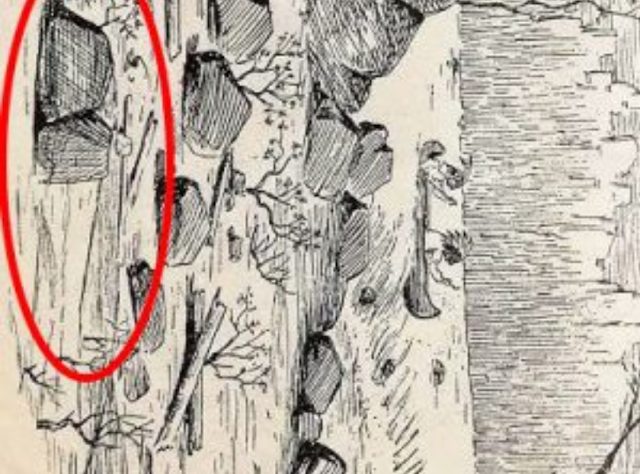
One of the most interesting features of this puzzle is the use of negative space.
Negative space refers to the areas around and between objects rather than the objects themselves.
In an ordinary landscape, an empty gap between two rocks is simply empty space.
In an optical illusion, that same gap can become part of a face.
A shadow may suddenly look like an eye socket.
A curved rock can become a cheek.
A gap between objects can help define the brim of a hat.
Your brain combines all these pieces into one larger interpretation.
Pareidolia: Why We See Faces Everywhere
Humans are particularly good at recognizing faces.
This tendency is sometimes associated with pareidolia, the phenomenon in which people perceive familiar patterns—especially faces—in ambiguous shapes.
It’s why people sometimes see faces in:
- Clouds
- Tree bark
- Mountains
- Buildings
- Shadows
- Rocks
- Household objects
Our brains are highly sensitive to facial patterns because recognizing faces is socially important.
Optical illusion artists can use this natural tendency to create images that initially look like one thing but reveal another image after closer inspection.
Don’t Stare Too Hard
One of the biggest mistakes people make with hidden-image puzzles is staring intensely at every individual detail.
That can actually make the puzzle harder.
Instead, try changing the way you look at the picture.
1. Step Back
Move several feet away from the screen if possible.
Reducing the image’s apparent size can make separate details blend together and reveal the larger shape.
2. Relax Your Eyes
Instead of examining every rock individually, soften your gaze.
A slightly unfocused view can make larger patterns easier to recognize.
3. Squint Slightly
Squinting reduces some of the smaller visual details and emphasizes larger shapes and contrasts.
You may suddenly notice that several unrelated objects form one recognizable outline.
4. Look at the Foreground
The canoe and its passengers naturally attract attention.
Try ignoring them.
Focus instead on the large rocks, shadows, and darker regions in the foreground.
5. Search for the Hat First
The hat is one of the most useful clues.
Rather than trying to identify an entire face immediately, look for the silhouette or brim of a hat.
Once your brain recognizes that feature, the rest of the face may become much easier to see.
6. Change the Orientation
Another interesting technique is to rotate the image or view it upside down.
Changing its orientation can disrupt your brain’s first interpretation of the scene.
When the familiar landscape no longer looks quite as familiar, the hidden facial structure may become easier to recognize.
The Canoe Is a Clever Distraction
The two people in the canoe serve an important visual purpose.
When viewers notice them, they naturally think:
“I’ve already found the people in this picture.”
That assumption can stop the search.
The hidden man isn’t another person physically standing somewhere in the landscape.
He’s a second interpretation of the landscape itself.
That’s why the puzzle can be surprisingly difficult even when the hidden face seems obvious once you’ve seen it.
Does Failing the Puzzle Mean Your Brain Is Getting Older?
No.
The phrase “your brain is still young” is a playful headline designed to make the puzzle more intriguing.
Failing to spot the hidden man quickly does not prove that someone has poor intelligence, weak memory, or cognitive decline.
Visual perception can vary because of many factors, including:
- Attention
- Familiarity with optical illusions
- Image size
- Lighting
- Visual experience
- Pattern-recognition habits
- Individual differences in perception
Someone might spot the face immediately, while another person could stare at the same image for several minutes before seeing it.
Neither result provides a meaningful assessment of brain health.
Why Optical Illusions Feel So Satisfying
There’s a special moment when an optical illusion finally “clicks.”
At first, you see nothing except a landscape.
Then suddenly, the rocks and shadows rearrange themselves in your mind.
You see a face.
And once you see it, it’s almost impossible to return to the original interpretation.
The picture hasn’t changed.
Your perception has.
That’s one of the most fascinating things about visual illusions.
The same lines, shapes, and shadows can support two completely different interpretations.
A Simple Lesson in How the Brain Sees
This puzzle demonstrates something important about human vision.
We don’t experience the world as a collection of disconnected pixels.
Our brains constantly organize what we see into meaningful objects and patterns.
That process is incredibly useful in everyday life.
It allows us to recognize a familiar person in a crowd, distinguish a car from its surroundings, or identify an object even when part of it is hidden.
But the same ability can also be manipulated.
An artist can arrange shapes so that your brain confidently sees one thing while another image is hiding in plain sight.
Can You See Him Now?
Take another look at the landscape.
Don’t concentrate on the canoe.
Don’t examine every tree.
Instead, step back and let the entire image become one composition.
Look toward the large foreground rocks and darker shapes.
Search for the outline of a man’s face and the brim of his hat.
Once your brain recognizes the basic structure, the hidden image should become much easier to identify.
And if you’ve already seen him, try looking away for a moment and then returning to the image.
You may find that the face now seems almost impossible to ignore.
Final Thoughts
This vintage landscape is much more than a picture of rocks, trees, water, and a canoe.
It is a carefully constructed hidden-image optical illusion that demonstrates how easily our perception can shift.
The man isn’t hiding behind the scenery.
He is hiding in the scenery.
The real challenge isn’t whether your brain is “young.” It’s whether you’re willing to question your first interpretation and look at familiar shapes from a different perspective.
Sometimes, seeing something new doesn’t require a different picture.
It only requires looking at the same picture differently.