
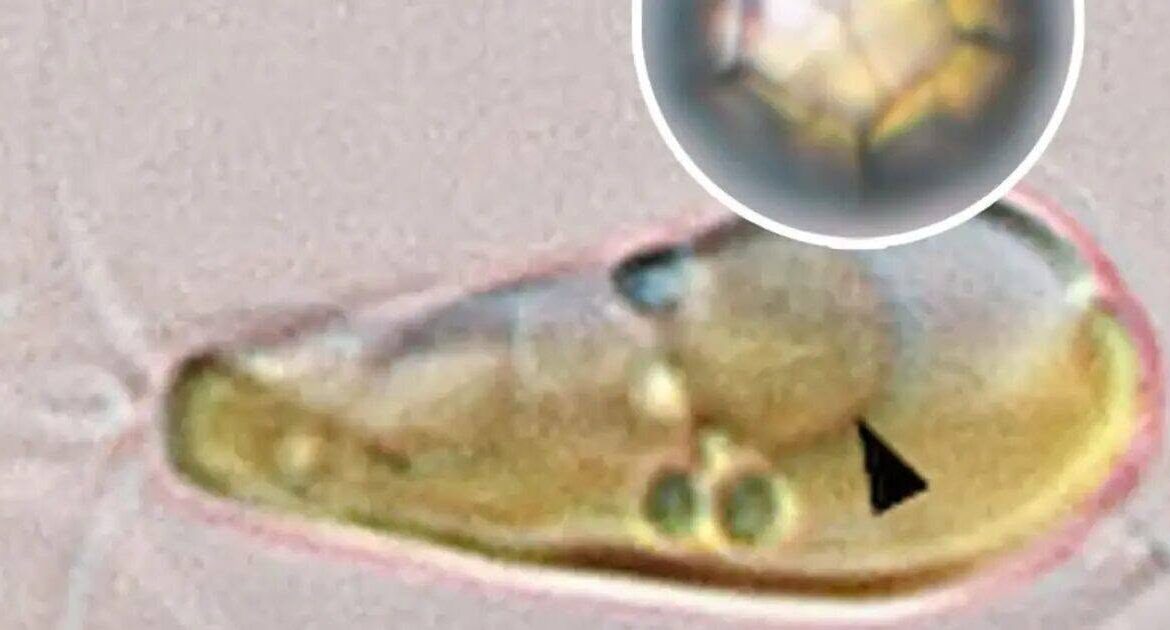
Researchers have reported observations of an exceptionally rare biological event involving a microscopic organism that could offer new clues about how complex life evolved on Earth. The discovery has sparked excitement among scientists because similar events may have played a crucial role in the origin of plants hundreds of millions of years ago.
Chapter 1: A Discovery That Surprised Scientists
For decades, scientists have believed that some of the most important evolutionary leaps happened only a handful of times in Earth’s long history. One such leap was the moment when a simple organism absorbed another organism and transformed it into a permanent partner. This process, known as endosymbiosis, eventually gave rise to structures such as chloroplasts, which allow plants to convert sunlight into energy.
Recently, researchers studying microscopic marine life identified a remarkable organism that appears to be undergoing a similar transformation. The finding immediately attracted attention because events of this kind are thought to be extraordinarily rare. Many experts had assumed that the major endosymbiotic events responsible for modern plant life were unique occurrences that happened hundreds of millions or even billions of years ago.The newly studied organism contains a tiny companion living inside its cells. Unlike ordinary symbiotic relationships, where two organisms simply benefit from one another, this partnership appears to be becoming much more integrated. Scientists believe the companion may be evolving into a permanent cellular component, much like chloroplasts did in ancient plant ancestors.
If confirmed, the discovery could provide researchers with a rare opportunity to witness a major evolutionary process while it is still unfolding.
Chapter 2: The Ancient Event That Changed Earth
Long before forests covered continents and flowering plants appeared, Earth was inhabited mostly by simple microscopic organisms. At some point, an ancestral cell engulfed a photosynthetic bacterium. Instead of digesting it, the host cell kept it alive.
Over time, the two organisms became inseparable. The captured bacterium gradually lost its independence and evolved into a chloroplast. This transformation allowed early algae and plants to harness sunlight more efficiently, ultimately changing Earth’s atmosphere and ecosystems.
Without this ancient partnership, life on Earth might look dramatically different today. Plants produce oxygen, form the base of countless food chains, and support ecosystems across the planet. Their existence can be traced back to these rare evolutionary mergers.
Scientists view the newly observed organism as potentially representing another step along a similar path. While it is not creating a new plant species, it may demonstrate how complex cellular structures can emerge through cooperation between different forms of life.
Chapter 3: What Makes This Case Special?The organism at the center of the discovery belongs to a group of marine microorganisms found in ocean environments. Researchers noticed that its internal companion appears unusually dependent on its host.
Normally, symbiotic organisms maintain a degree of independence. However, in this case, the internal partner may be losing genes that are no longer necessary because the host provides essential resources. Such genetic streamlining resembles patterns observed in ancient endosymbiotic events.
Scientists have also found evidence suggesting that the host cell is beginning to regulate the behavior of its internal companion. This level of coordination is one of the hallmarks of a deeper biological integration.The findings suggest that evolution may still be capable of producing transformative partnerships even in the modern world. Rather than being relics of the distant past, these processes could remain active today under the right conditions.
Chapter 4: Why Researchers Are Excited
The possibility of observing an evolutionary transition in real time is incredibly valuable. Most major evolutionary events occurred so far in the past that scientists must reconstruct them from fossils, genetics, and indirect evidence.
This discovery provides a living system that can be studied directly. Researchers can monitor genetic changes, cellular interactions, and adaptations as they happen. Such observations may reveal details that have remained hidden for generations.
Beyond evolutionary biology, the findings could have implications for biotechnology, ecology, and our understanding of life’s adaptability. By learning how organisms merge functions and share resources, scientists may gain insights into new biological mechanisms and future applications.
The discovery also highlights how much remains unknown about microscopic life in Earth’s oceans. Despite centuries of scientific exploration, countless organisms and biological processes have yet to be fully understood.
Chapter 5: A Window Into Life’s FutureAlthough researchers remain cautious, many agree that the organism represents one of the most intriguing biological discoveries in recent years. Further studies will be needed to determine exactly how advanced the integration has become and whether it truly mirrors ancient evolutionary milestones.
If future research confirms current observations, scientists may be witnessing a rare example of a new organelle emerging inside a living organism. Such events are believed to occur only rarely across geological timescales.
The discovery serves as a reminder that evolution is not merely a story of the distant past. It is an ongoing process that continues to shape life in ways both visible and hidden. Deep within microscopic cells, changes may be taking place today that could influence the future of life on Earth for millions of years to come.