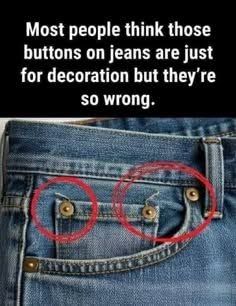
Most People Think Those Little Buttons on Jeans Are Just Decoration — Here’s What They’re Really For
Have you ever looked closely at your favorite pair of jeans and wondered why there are tiny metal buttons attached around the pockets?
They may look like simple decorative details, but those little pieces of metal have a surprisingly practical history. They were created to solve a problem that workers faced more than 150 years ago—and they eventually became one of the most recognizable features of denim.
Those small metal pieces are called rivets, and their original purpose was simple: to make the weakest parts of denim clothing stronger and more durable.
Today, jeans are worn everywhere—from casual weekends and everyday errands to offices, travel, and outdoor activities. But their design comes from a time when denim trousers were primarily made for people doing physically demanding work.
What Are Those Tiny Metal Buttons on Jeans?
Those little metal pieces are known as rivets.
Unlike ordinary buttons, rivets aren’t primarily designed to fasten clothing. They are used to reinforce areas where denim experiences significant stress, particularly around pocket openings and seams.
A rivet is essentially a small metal fastener that passes through layers of fabric and helps hold them securely together.
When someone puts their hands into a pocket, pulls something out, or carries a heavy object, the fabric around the pocket can experience repeated tension.
Stitching alone can eventually weaken.
The rivet helps distribute some of that stress and makes the connection between the fabric pieces stronger.
So, although modern jeans may use rivets partly because of tradition and style, the original idea was highly functional.
Why Did Jeans Need Rivets?
To understand the purpose of rivets, it helps to look at the history of denim.
During the 19th century, durable trousers were especially valuable to workers who spent long hours performing physically demanding jobs.
Miners, railroad workers, farmers, mechanics, and other laborers needed clothing that could withstand constant wear.
Pockets were particularly vulnerable.
Workers often carried tools, coins, equipment, and other objects in them. Repeated pulling and movement could place considerable stress on pocket seams.
A pair of trousers could be made from strong fabric, but if the stitching around a pocket failed, the garment could still become damaged.
That created an opportunity for a simple but clever improvement.
Who Invented the Riveted Jeans Design?
The story is closely connected to Jacob Davis, a tailor who worked with denim garments in the American West.
Davis reportedly developed the idea of using metal rivets to reinforce areas of work trousers that were prone to tearing.
He eventually contacted businessman Levi Strauss, whose company supplied fabric.
The two worked together on the design, and in 1873, they received a U.S. patent for the riveted clothing design.
The invention helped establish a construction method that would become closely associated with the future of blue jeans.


The Genius Was in the Weak Points
The interesting thing about rivets is that they weren’t added randomly.
They were placed where the fabric needed additional reinforcement.
Think about the stress placed on a jeans pocket.
Every time you put your hands inside, pull something out, sit down, stand up, or carry something heavy, the fabric around the pocket moves.
Over hundreds or thousands of repetitions, that stress can weaken stitching.
A metal rivet provides additional reinforcement at the connection point.
It was a small design change with a potentially significant effect on durability.
A Simple Engineering Solution
The concept can be summarized in three steps:
- Identify the weakest point.
- Add a strong fastener at that location.
- Reduce the likelihood of the fabric pulling apart.
It’s a good example of how practical engineering can become part of everyday design.
They Weren’t Originally About Fashion
Today, rivets are practically synonymous with denim fashion.
You can find them on classic blue jeans, black jeans, vintage denim, workwear, and designer styles.
But that wasn’t the original purpose.
The early riveted trousers were intended to be durable work clothing, not a fashion statement.
The metal components helped reinforce the garment and made it better suited to demanding conditions.
Over time, however, the practical feature became part of the visual identity of jeans.
That’s one reason the small copper-colored rivets remain recognizable today.