Doctors say nail changes are among the earliest and most overlooked signs of serious underlying health conditions. Here’s what each type of nail line really means — and when to act immediately.
Most of us barely glance at our nails beyond grooming them. But for decades, physicians and dermatologists have known a quiet truth: your nails are one of the most accessible windows into your internal health. Changes in color, texture, shape, and the appearance of unusual lines can reflect what’s happening deep inside your body — often before any other symptoms become noticeable.
This becomes especially relevant after age 40. As we get older, the body becomes less efficient at hiding early signs of dysfunction. Circulatory changes, nutritional shifts, organ stress, and even early-stage cancers can manifest visibly at the nail — sometimes months before a clinical diagnosis would otherwise occur. The nails are not causing these conditions; they’re reporting them.
This article explains exactly what the four most medically significant types of nail lines look like, what health conditions they are associated with, and — critically — which ones require you to see a doctor without delay. If you’ve noticed any unusual changes in your nails recently, this is worth reading carefully.
At a Glance: 4 Types of Nail Lines and What They Signal
| Type of Nail Line | Possible Health Link | Urgency Level |
|---|---|---|
| Horizontal Lines (Beau’s Lines) | Past illness, stress, diabetes, circulation issues | Moderate — See a Doctor |
| Vertical Ridges | Aging, iron deficiency, Vitamin B12 shortage | Monitor — Worth Checking |
| Dark Streaks | Melanoma (nail cancer) — most serious | ⚠ Urgent — See Doctor Now |
| White Lines (Muehrcke’s Lines) | Liver disease, kidney disease, low protein | Moderate — See a Doctor |
The 4 Nail Lines Explained in Detail
Beau’s lines are horizontal grooves or indentations that run across the width of the nail plate, perpendicular to the direction of nail growth. They appear when nail growth is temporarily interrupted — something that only happens when the body is under significant physiological stress.
Think of them like rings in a tree trunk: each Beau’s line marks a specific period when the body was under enough stress to slow or halt nail production. Because nails grow at a relatively predictable rate (about 3mm per month for fingernails), the location of a Beau’s line on the nail can even give a rough indication of when the triggering event occurred.
After age 40, Beau’s lines are particularly worth noting because the conditions that cause them become more common with age — and because the body’s recovery from systemic stress becomes slower, meaning the lines may be more pronounced.
What causes Beau’s lines? Common triggers include severe illness (particularly high fever), major surgery, significant psychological stress, malnutrition, chemotherapy, and uncontrolled chronic conditions including diabetes and peripheral vascular disease. They may appear on one nail (suggesting local trauma) or all nails simultaneously (suggesting a systemic cause).
Potentially Linked Conditions
Vertical ridges — lines that run from the cuticle toward the tip of the nail — are the most common nail change seen in adults over 40, and in many cases they are a normal part of the aging process. The nail matrix (the tissue responsible for nail production) becomes less efficient with age, producing slightly uneven nail plates with fine longitudinal ridges.
However, the key distinction is between the gentle, uniform ridging that comes with normal aging and unusually deep, uneven, or suddenly appearing vertical ridges. The latter can signal underlying health issues that deserve attention — particularly nutritional deficiencies that become increasingly common in the over-40 population.
When are vertical ridges concerning? Deep or suddenly worsening ridges, particularly when accompanied by nail brittleness, splitting, or spooning (nails that curve upward like a spoon — called koilonychia), may indicate iron deficiency anemia, Vitamin B12 deficiency, or thyroid dysfunction. These conditions are highly treatable when caught early, making the nail signal valuable.
Vitamin B12 deficiency in particular is dramatically underdiagnosed in adults over 50, who absorb it less efficiently from food. If your vertical ridges are worsening alongside fatigue, brain fog, or tingling in the hands and feet, a simple blood test can confirm or rule out a deficiency.
Potentially Linked Conditions
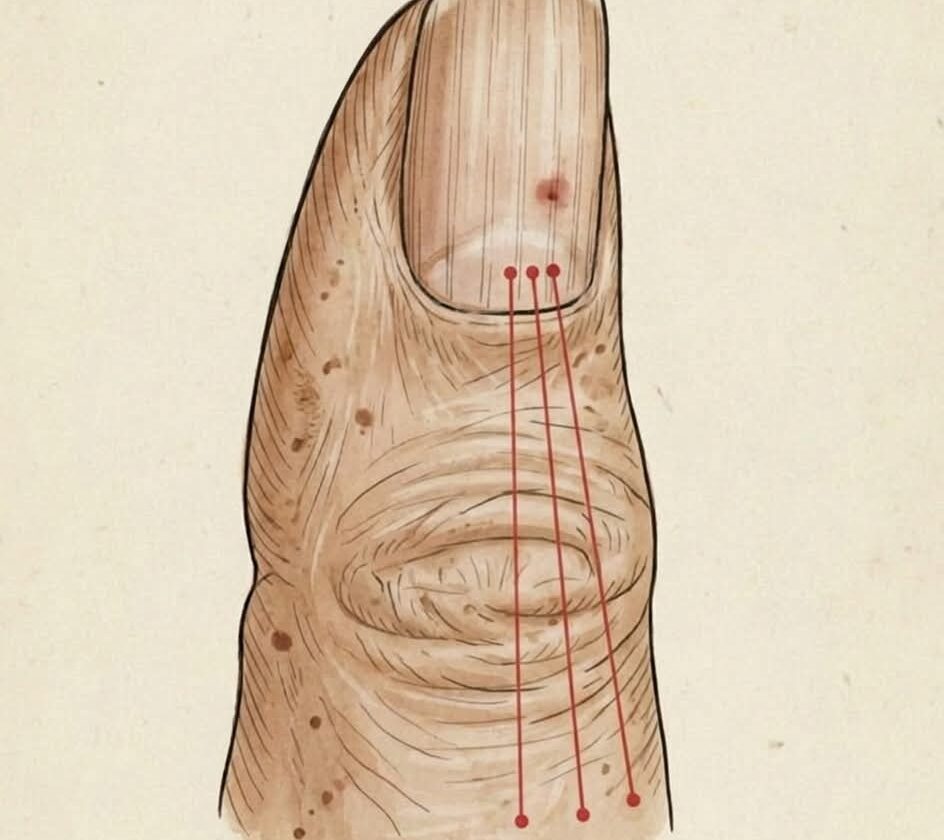
This is the nail change that requires the most immediate attention — and the one most commonly dismissed as a bruise or minor injury. A dark brown or black streak running lengthwise under the nail (called melanonychia striata) can be completely benign, but it can also be the first visible sign of subungual melanoma — a form of skin cancer that develops under the nail plate.
Subungual melanoma is rare but disproportionately deadly — not because it is inherently more aggressive than other melanomas, but because it is so frequently misidentified and therefore diagnosed late. It most commonly appears under the thumbnail or big toenail, but can occur under any nail. The condition is more common in adults over 40 and does not require sun exposure to develop, unlike most other melanomas.
How to tell a concerning streak from a benign one: Benign causes of dark nail streaks include minor trauma (which usually grows out over weeks), certain medications, and a benign condition called a nail matrix nevus. However, no one without medical training should attempt to make this distinction at home. The clinical rule is straightforward: any new, unexplained dark streak under a nail in an adult over 40 should be evaluated by a dermatologist without delay.
Dermatologists use a tool called a dermoscope to examine the streak in detail — the evaluation is quick, painless, and completely non-invasive. When subungual melanoma is caught at an early stage, the outcomes are dramatically better than when diagnosis is delayed.
Potentially Linked Conditions
Muehrcke’s lines are paired white horizontal bands that run across the nail parallel to the lunula (the white half-moon at the nail base). Unlike Beau’s lines, which are physical grooves in the nail plate itself, Muehrcke’s lines are changes in the nail bed (the tissue under the nail) — meaning the nail surface remains smooth to the touch. When you press on the nail, the lines temporarily disappear, which is a clinical hallmark of this condition.
These lines were first described in 1956 by Dr. Robert Muehrcke, who noted them specifically in patients with severely low serum albumin — a protein produced by the liver that is essential for fluid balance, immune function, and transporting hormones and nutrients in the blood. Low albumin is a reliable indicator of significant liver or kidney dysfunction, or of severe protein malnutrition.
After age 40, the conditions most commonly associated with Muehrcke’s lines include chronic liver disease (including cirrhosis and hepatitis), chronic kidney disease and nephrotic syndrome, and malnutrition or severe dietary protein deficiency. Chemotherapy can also cause them. They typically appear on multiple nails simultaneously rather than on a single nail.
If Muehrcke’s lines appear and the underlying condition is successfully treated — bringing albumin levels back to normal — the lines will typically resolve on their own over time.
Potentially Linked Conditions
🚨 When to See a Doctor — Don’t Wait on These Signs
- Any new dark streak (brown or black) under a nail that appeared without a clear injury — see a dermatologist urgently
- White lines (Muehrcke’s lines) appearing on multiple nails simultaneously
- Horizontal grooves (Beau’s lines) appearing across all nails at once — suggests a systemic cause
- Vertical ridges that are rapidly deepening, or accompanied by nail brittleness, splitting, or spooning
- Any nail changes accompanied by fatigue, swelling, shortness of breath, yellowing of skin, or changes in urination
- Nail changes in combination with unexplained weight loss, persistent pain, or abdominal swelling
How to Support Healthy Nail Growth After 40
While nail changes often reflect deeper health conditions that require medical attention, there are also lifestyle factors that meaningfully support nail health as we age.
Adequate Protein Intake
Nails are made of keratin — a protein. Insufficient dietary protein directly weakens nail structure and slows growth.
Key Micronutrients
Iron, Biotin, Zinc, and Vitamins B12, C, and D all play direct roles in nail strength. Consider a blood panel to check your levels.
Hydration
Chronic dehydration causes brittle nails and worsens ridging. Aim for consistent daily water intake throughout the day.
Regular Check-Ups
Annual blood work after 40 checks liver function, kidney function, blood sugar, and nutrient levels — the conditions most linked to nail changes.
Moisturize & Protect
Frequent hand washing and chemical exposure dry out nails. Use cuticle oil and wear gloves for cleaning tasks to reduce physical damage.
Monthly Self-Check
Make it a habit to examine all 20 nails (fingers and toes) monthly in good light. Catching changes early is the whole point.
Frequently Asked Questions
Not always — fine vertical ridges are a common and normal part of aging. The nail matrix becomes less efficient over time, producing slightly uneven nail plates. However, if your vertical ridges are deepening noticeably, appearing suddenly, or accompanied by other symptoms like fatigue, brittle nails, hair thinning, or cold intolerance, they may indicate nutritional deficiencies (particularly iron or B12) or thyroid dysfunction. A simple blood test can check all of these quickly. The rule of thumb: gradual, symmetrical ridging is usually age-related; sudden or rapidly worsening changes warrant investigation.
Yes — you should see a dermatologist, and you should not wait. A dark streak that appeared without a clearly remembered injury (like dropping something on your finger) needs to be professionally evaluated. The examination itself is quick and painless — a dermatologist uses a handheld dermoscope to assess the streak’s characteristics in detail. Most dark nail streaks do turn out to be benign, but the cases that are subungual melanoma are far too serious to leave to chance. When it comes to unexplained dark nail streaks in adults over 40, the correct default is prompt evaluation.
The key difference is physical structure. Beau’s lines are actual grooves or indentations in the nail plate itself — you can feel them if you run a finger across the nail surface. They run horizontally across the nail and represent a disruption in nail growth. Muehrcke’s lines, by contrast, are changes in the nail bed (the tissue beneath the nail) — the nail plate surface remains completely smooth. Muehrcke’s lines also temporarily disappear when you press on the nail (because pressing compresses the nail bed blood vessels, temporarily blanching the white lines), while Beau’s lines remain visible regardless of pressure.
In most cases, yes. Because nails grow continuously (fingernails at about 3mm per month, toenails more slowly), treating the underlying cause and allowing healthy nail growth to continue will eventually replace the affected portion of the nail with healthy tissue. Muehrcke’s lines typically resolve when albumin levels normalize. Beau’s lines grow out as the nail grows. Vertical ridges from nutritional deficiency often improve significantly once the deficiency is corrected. Dark streaks from benign causes (like medications or minor trauma) also grow out. The exception is permanent structural damage — but even then, treating the underlying cause remains essential.
A monthly nail self-examination is a simple, zero-cost habit that can catch changes early. Do it in good lighting — natural daylight is ideal — and examine all 20 nails including your toenails, which are often overlooked. Look for new dark streaks, changes in color (especially yellowing or whitening), changes in texture (sudden ridging, pitting, or separation from the nail bed), and changes in shape. If you notice anything new or unusual, photograph it with your phone so you have a record for your doctor. The goal isn’t to diagnose yourself — it’s to notice and report changes early, when they’re most actionable.
You May Also Like
7 Body Warning Signs After 40 That Doctors Say You Should Never Ignore
Health Warning Signs
Signs of Vitamin B12 Deficiency That Most People Miss After 50
Nutritional Health
Early Warning Signs of Liver Disease — What Your Body Is Telling You
Organ Health
What Your Feet Can Reveal About Your Heart and Circulation Health
Cardiovascular Health
The 10 Most Important Blood Tests Everyone Over 40 Should Get Annually
Preventive Care
Iron Deficiency After 40: Symptoms, Causes, and the Best Dietary Sources
Nutrition & Deficiencies
Your Nails Are Always Talking. It’s Worth Listening.
Your nails don’t change by accident. Every ridge, line, discoloration, and groove is the result of something happening inside your body — sometimes something minor, sometimes something that deserves immediate attention.
After 40, giving your nails a monthly look costs nothing and could reveal something important before other symptoms emerge. If you notice anything unusual — especially a dark streak — don’t rationalize it away. A quick appointment with a dermatologist is always worth the peace of mind.
Share this article with someone over 40 who should read it. It could make a real difference. 🖐️